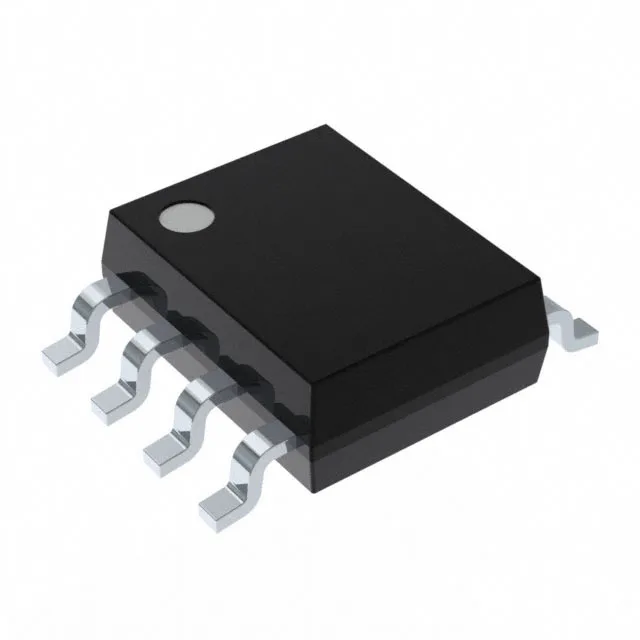
5V fixed output, ±0.06% — the precision floor for your ADC reference
That number is the first thing to check when you're budgeting the error budget for a 16-bit or higher ADC — a 0.06% reference error consumes only about 10 LSBs at 16 bits, leaving headroom for the converter's own INL and noise. The 3ppm/°C temperature coefficient means the output shifts less than 1.5 mV over the full -40°C to +125°C range, which keeps the reference stable across industrial thermal cycling without a precision oven or external compensation. The part is a series (shunt-free) topology, which means it can source up to 30 mA while drawing only 700 µA of its own supply current. That 30 mA is enough to drive multiple ADC reference inputs, a DAC, and an op-amp front-end from one device — but if you need more, you'll buffer it. The wide 7V to 40V input range lets you run it directly off an unregulated 12V or 24V rail without a pre-regulator, saving a linear regulator and its dropout voltage.
Noise floor: 9 µVp-p low-frequency, 14.5 µVrms broadband
The broadband noise from 10 Hz to 10 kHz is 14.5 µVrms, a figure that keeps the reference from dominating the noise floor in a 24-bit sigma-delta ADC system.
Package and footprint: 8-SOIC, standard layout
The MAX6175AASA+T comes in an 8-SOIC package with a body width of 3.90 mm (0.154").