Active — but the RoHS flag is the real gotcha
The MAX6023EBT21: The catch: this part is RoHS non-compliant. If your BOM requires RoHS-10 (EU 2015/863), this variant won't pass incoming inspection.
2.048 V fixed output with ±0.2% initial accuracy — a 12-bit ADC reference sweet spot
This is a series voltage reference with a fixed 2.048 V output. For a 12-bit ADC with a 2.048 V full-scale range, that works out to exactly 1 mV per LSB — no scaling resistors or level shifters needed. The ±0.2% initial tolerance means the reference itself contributes less than 0.5 LSB of gain error at 12 bits without any external trim. The 35 µA quiescent current keeps the power budget low — suitable for battery-powered instruments that leave the reference on continuously between conversions.
30 ppm/°C drift — where the precision budget goes
Temperature coefficient is 30 ppm/°C typical. For a 12-bit system with 1 mV LSB, that's under 4 LSBs of drift — acceptable. For a 16-bit system with 31.25 µV LSB, the same drift is 120 LSBs, and you'd need a lower-drift reference or a software calibration loop. The 10 Hz to 10 kHz noise is 105 µVrms. If your ADC sampling rate is below 10 Hz, the low-frequency noise dominates the input-referred noise floor.
5-UCSP (1x1.52 mm) — tiny footprint, no leads, tough to rework
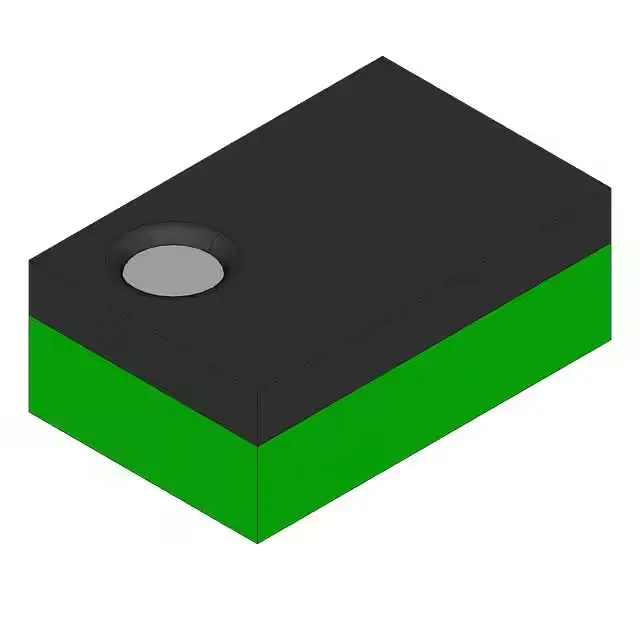
Package is a 5-ball wafer-level chip-scale package (UCSP) measuring 1 × 1.52 mm. There are no leads — the solder balls are the only electrical and mechanical connection. This means the PCB footprint is the ball pattern, and the solder-paste stencil aperture needs to match the ball diameter exactly. X-ray inspection is recommended to verify solder-joint integrity after reflow. The supplier device package code is 5-UCSP (1x1.52). A 4-layer board with microvias helps fan out the signals — two-layer boards struggle to route all five balls without via-in-pad.
Output current capability is 500 µA maximum. That's enough to drive a single ADC reference input or a non-inverting buffer, but not multiple loads or a long trace with high capacitance. If the load exceeds 500 µA, the output voltage drops out of regulation.