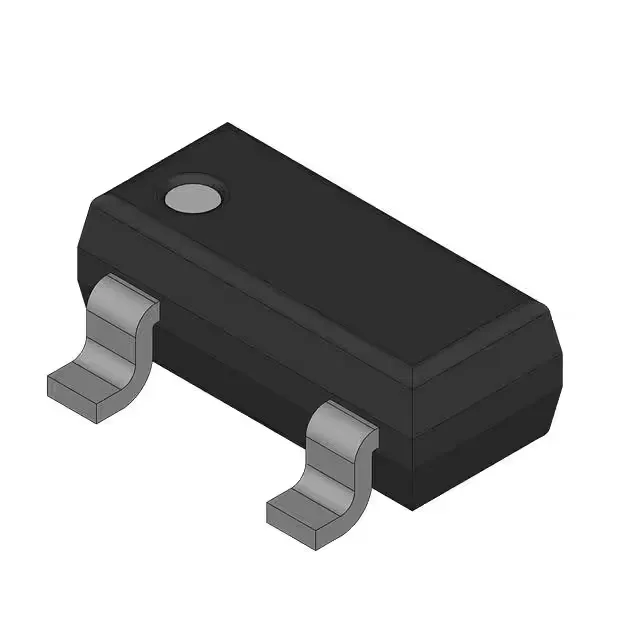
SOT-23-3 footprint and board integration
The MAX6012AEUR: The three-pin footprint is common across many small-signal references and regulators, so the PCB land pattern is well-established and does not require a custom pad stack. For a device drawing 35 µA supply current and sourcing up to 500 µA, self-heating is negligible, so no special thermal vias are needed.
1.247 V fixed output with ±0.32% initial tolerance
The fixed 1.247 V output is a bandgap-derived series reference. The ±0.32% initial tolerance sets the absolute accuracy floor at 25°C — for a 1.247 V reference, that is roughly ±4 mV. This is tighter than a generic 1% reference but not as tight as a 0.1% grade; it suits 8- to 10-bit ADC references where the reference error is a fraction of the LSB. Over a 125°C span, the worst-case drift is 20 ppm/°C × 125°C = 2500 ppm, or about 3.1 mV. This is consistent with a mid-grade bandgap reference and is adequate for industrial sensor conditioning where the system is calibrated at temperature.
Input range and load drive
The series reference can source up to 500 µA to the load while drawing only 35 µA from the input — the load current is delivered through the pass element, so the efficiency is high at light loads. If the load exceeds 500 µA, the output drops out of regulation.