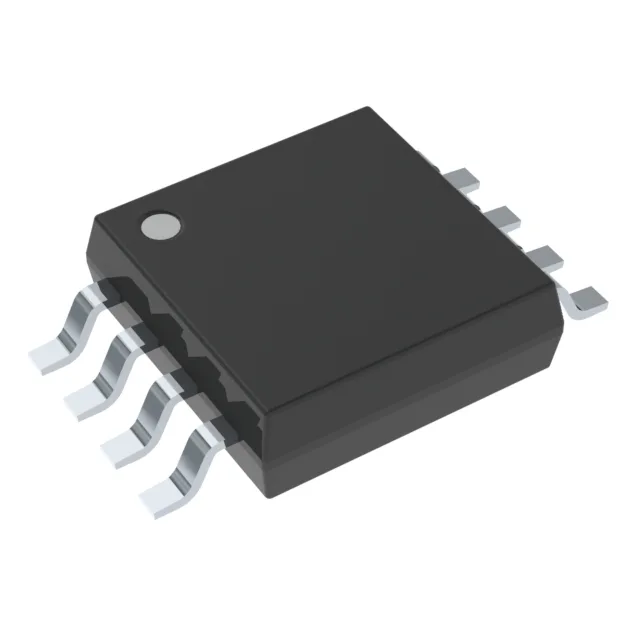
The Maxim MAX5721EUA+ is a dual 10-bit voltage-output DAC using a String DAC architecture, packaged in an 8-uMAX/uSOP (3mm × 3mm) surface-mount package. Two independent DAC channels in this footprint let you replace two single-channel DACs with one IC, freeing board area and reducing component count on mixed-signal boards where two analog outputs are needed — programmable voltage references, bias trims, or set-point generation in industrial control loops.
10 µs settling — sizing the update rate for your control loop
Settling time to ±0.5 LSB is 10 µs typical, which sets the per-channel update ceiling at roughly 100 kHz full-scale steps. The SPI/DSP-compatible serial interface clocks in the data, and an external reference sets the output span — so the accuracy of the reference voltage directly determines the absolute output accuracy.
Linearity spec — ±0.5 LSB INL keeps monotonicity across temperature
Integral nonlinearity is ±0.5 LSB typical, ±1 LSB maximum; differential nonlinearity is ±0.5 LSB typical, ±1 LSB maximum. The max DNL of ±1 LSB guarantees monotonic output — every increase in digital code produces a non-decreasing analog voltage — which matters when the DAC is used in a closed-loop trim or calibration path where a non-monotonic step would cause the loop to hunt or latch.
Supply rails — single-supply simplicity
Both the analog and digital supply pins share the same 2.7 V to 5.5 V range, so a single 3.3 V or 5 V rail powers the entire DAC. No separate analog supply needed, which simplifies the power-tree design and reduces decoupling complexity on the board. The buffered voltage output can drive moderate loads directly — no external op-amp needed for typical interface or trim applications.
Package and handling — 8-uMAX, MSL check before reflow
Housed in an 8-uMAX/uSOP, also described as 8-TSSOP/8-MSOP with 0.118-inch body width. This is a standard fine-pitch surface-mount package — the footprint matches the common 8-MSOP land pattern. The part ships in Tube. MSL level is not stated in this record, but Maxim's uMAX packages are typically MSL 1, so a bake before reflow is generally not needed unless the sealed bag has been breached.