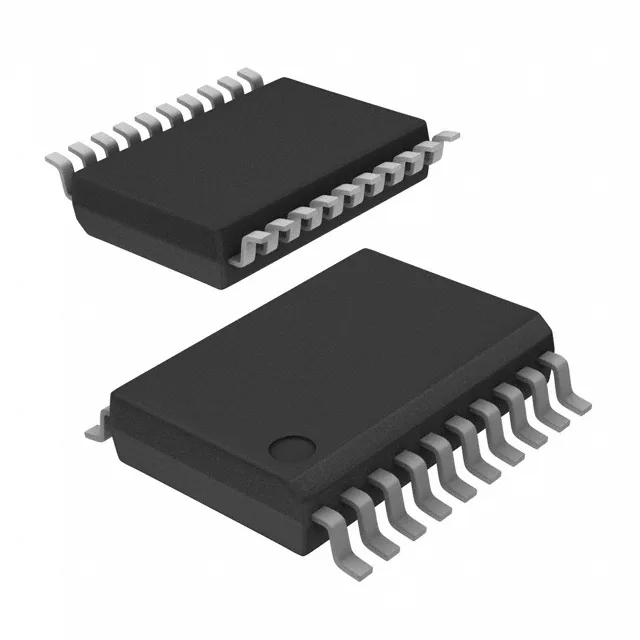
Six-channel reinforced isolator for high-speed industrial links
The Maxim Integrated MAX22565CAAP+ is a 6-channel reinforced digital isolator using capacitive coupling technology, designed to pass data across an isolation barrier at up to 200 Mbps while withstanding 3750 Vrms of isolation voltage. It supports multiple serial protocols including CAN, RS232, RS422, RS485, and SPI, making it a flexible choice for breaking ground loops in industrial communication interfaces, motor drives, and isolated sensor links. The unidirectional channel configuration provides five channels on side 1 and one channel on side 2, a common arrangement for SPI isolation where the clock, data, and chip-select signals travel one way and the MISO return path uses the single reverse channel.
200 Mbps and 50 kV/µs CMTI — what these ratings mean for your design
The 200 Mbps data rate covers high-speed SPI buses running at 50 MHz or faster, and the 9.5 ns / 9.9 ns propagation delay (tpLH/tpHL max) keeps timing margins tight for clocked interfaces. Pulse width distortion is held to 2 ns max, which matters for maintaining duty cycle on serial data streams. Rise and fall times of 0.8 ns and 1 ns typical mean the edges are fast enough for 200 Mbps but may need controlled-impedance layout on the PCB to avoid ringing.