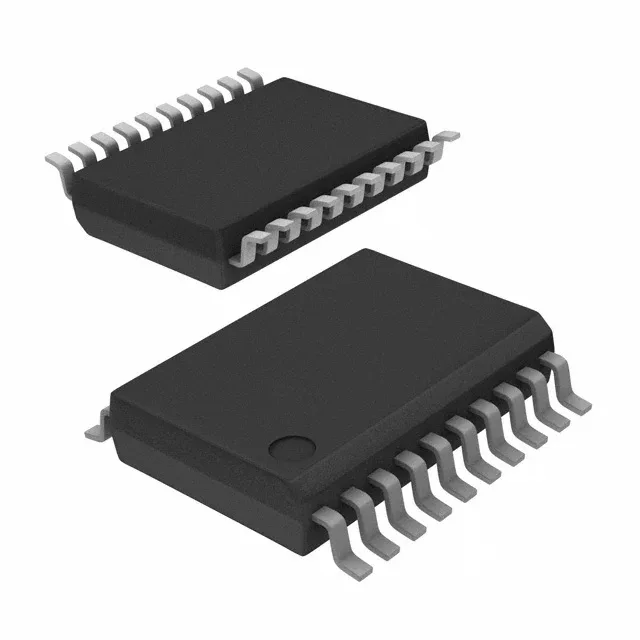
200 Mbps quad-channel isolator for multi-protocol bus isolation
The Maxim Integrated MAX22344CAAP+ is a 4-channel digital isolator using capacitive coupling technology, rated for 3750 Vrms isolation and a 200 Mbps data rate. It supports CAN, RS422, RS485, and SPI protocols across its four unidirectional channels (4 inputs on side 1, 0 on side 2).
Maximum propagation delay is 9.2 ns (tpLH) and 9.4 ns (tpHL), with pulse-width distortion capped at 2 ns. These numbers keep the timing budget tight for high-speed SPI at 200 Mbps and for CAN FD where bit timing margins are already squeezed. Common-mode transient immunity is a minimum of 50 kV/µs — critical when the isolator sits across a motor-drive or inverter ground bridge where fast switching edges try to couple through the barrier. The 0.8 ns / 1 ns rise/fall times (max) preserve signal integrity on short PCB traces.
Housed in a 20-SSOP package (0.209", 5.30 mm width), surface-mount only. The supply range from 1.71V to 5.5V covers 1.8V, 2.5V, 3.3V, and 5V logic rails without needing a separate level shifter — a single part bridges a 1.8V MCU SPI to a 5V CAN transceiver, for instance. No isolated power is generated on-chip; the part is a signal isolator only, so each side needs its own supply.