What this controller does and where it fits
The MAX1993ETG+ is a single-phase, step-down (buck) PWM controller from Analog Devices' Quick-PWM™ series. The switching frequency is pin-selectable among 200 kHz, 300 kHz, 450 kHz, and 600 kHz, letting you trade inductor size against switching loss. The 100 % duty-cycle capability means the high-side switch can stay on continuously — useful when the input voltage drops close to the output target, reducing dropout. This is a controller IC, not a module; it needs external FETs, an inductor, and compensation. It targets point-of-load regulation in systems that already have a 5 V bias rail — networking gear, base stations, industrial control boards.
Four selectable frequencies (200, 300, 450, 600 kHz) let you optimize the inductor value and output ripple. A 600 kHz design uses a smaller inductor but increases switching losses in the external FETs; 200 kHz cuts those losses but needs a larger inductor and more output capacitance to meet the same ripple target. The controller does not have clock synchronization (no SYNC pin), so the switching frequency is fixed by the pin-strap. That is fine for single-rail designs; in multi-rail systems with beat-frequency concerns, you would need a synchronizable part. Control features include current limit, enable, on-time control, power-good output, pulse-skipping at light loads, and a saturation flag. The pulse-skipping mode improves efficiency at low output current — the controller simply skips switching cycles instead of forcing a minimum on-time.
Package, temperature grade, and board integration
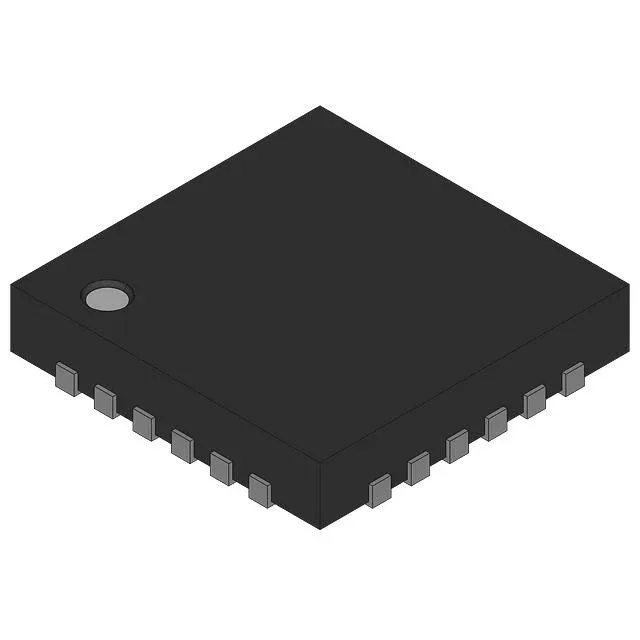
Housed in a 24-lead WFQFN with exposed pad (4×4 mm body, 0.50 mm pitch). This covers most indoor and outdoor telecom, networking, and industrial enclosures. The part is supplied in tube packaging (not tape-and-reel), which matters for automated pick-and-place — confirm the feeder compatibility for tube-fed QFN packages on your line.
Lifecycle and compliance documentation
If you need a dual-source hedge, the controller's function is generic enough that a parametric search on Vcc range, frequency options, and package would turn up alternatives from other vendors — but the Quick-PWM architecture and the specific control feature set (saturation flag, pulse-skipping) are unique to this part.