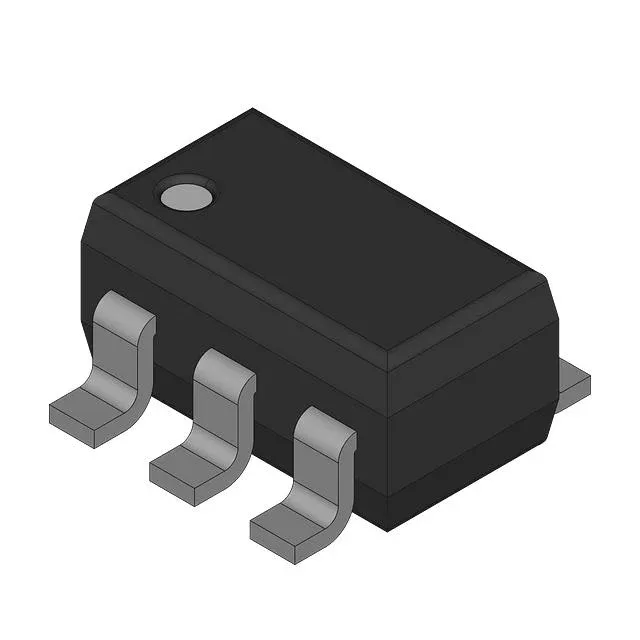
SOT-23-6 boost converter — fixed 3.3 V rail for portable gear
The MAX1833EUT is a step-up (boost) DC-DC converter from Analog Devices, delivering a fixed 3.3 V output from an input as low as 1.5 V and as high as 5.5 V. It is a single-output, positive-configuration converter rated for 150 mA continuous output current. The internal synchronous rectifier replaces the usual external Schottky diode, which improves efficiency at light loads and reduces the external BOM to just the inductor, input cap, and output cap. The fixed 3.3 V output means no feedback resistor divider is needed — the output voltage is set internally. Housed in a SOT-23-6 package (six pins, 0.95 mm pitch), it fits into compact designs where board space is tight — think battery-powered handhelds, IoT sensor nodes, or single-cell Li-ion to 3.3 V rails.
One important compliance note: this part is RoHS non-compliant. It contains lead or other restricted substances per the EU RoHS directive. If your BOM requires full RoHS compliance, you will need to source a compatible alternative or apply for an exemption.
What the 150 mA rating means for your rail budget
The 150 mA output current is the continuous rating — the converter can supply that much to the load while regulating at 3.3 V. For a typical wireless sensor drawing 50 mA in transmit and 5 µA in sleep, the MAX1833EUT has headroom for the peak current plus the extra margin needed for the inductor ripple current. The minimum input voltage of 1.5 V means it can start from a nearly depleted single-cell alkaline battery (0.9 V typical endpoint) or a Li-ion cell (3.0 V nominal, down to 2.5 V under load). The 5.5 V maximum input covers two-cell alkaline or a USB 5 V rail with margin. Because the output is fixed at 3.3 V, there is no feedback pin to route — the layout is simpler than an adjustable converter. The synchronous rectifier also means the inductor current path is through the internal FETs, not an external diode, so the thermal dissipation is lower at moderate loads.
This variant ships in Bulk, which means loose parts in a bag or tube rather than tape-and-reel. For prototype runs, lab builds, or low-volume production, bulk is fine. For high-volume pick-and-place, you will want the tape-and-reel version — check the MAX1833EUT family for the -T suffix if available.