Boost and SEPIC from a single inductor
The MAX1790EUA+ is a current-mode step-up DC-DC converter that also supports SEPIC topology — meaning it can generate an output above, below, or equal to the input voltage from a single inductor. The internal switch is rated for 1.2 A peak current — that is the FET's current limit, not the continuous output. For a typical 3.3 V input to 5 V output step-up, the maximum continuous output current is around 600 mA before the switch hits its limit; the actual number depends on the input-to-output ratio and the inductor ripple.
Switching frequency trade-off
The oscillator runs at either 640 kHz or 1.22 MHz, selected by a logic pin. At 1.22 MHz the inductor can be smaller — a 4.7 µH part works for most boost designs — but switching losses in the external Schottky diode and the internal FET increase, pulling efficiency down a few points. At 640 kHz the inductor is roughly twice the value (10 µH typical), but the efficiency peaks higher, especially at light loads. Because there is no synchronous rectifier, the external diode's reverse recovery charge matters at 1.22 MHz — a fast Schottky like the BAT54 or SS12 keeps the switching node from ringing and eating into the efficiency gain from the smaller inductor.
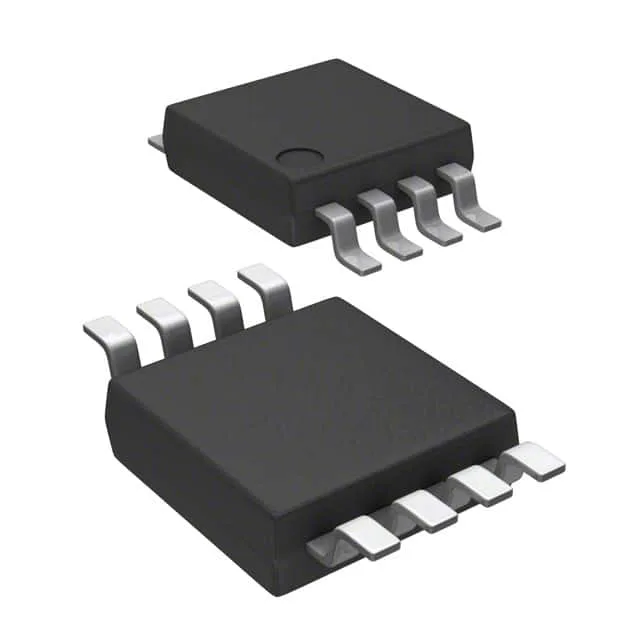
Housed in an 8-pin MSOP (also described as 8-TSSOP, 0.118" wide, 3.00 mm body width) with the supplier device package designated 8-uMAX/uSOP. The 0.65 mm pin pitch and exposed leadframe mean a standard two-layer board with a solid ground plane under the IC handles the thermal dissipation for most designs up to the 1.2 A switch limit.
RoHS3 compliant with no exemptions — fully lead-free, suitable for RoHS-driven BOMs without a waiver.