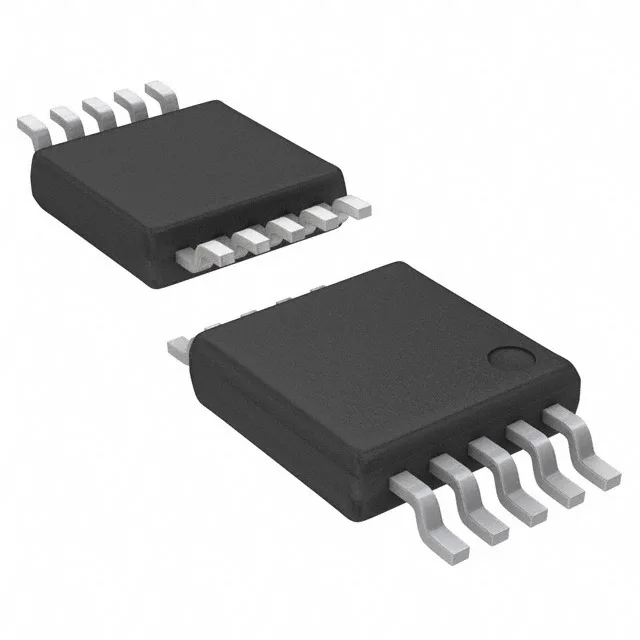
The MAX1759EUB+T: ROHS3 compliance is confirmed, which simplifies EU and global market regulatory acceptance without requiring an exemption review.
Charge pump topology — why step-up/step-down matters
This is a switched-capacitor charge pump, not an inductor-based converter. The 1.5 MHz switching frequency keeps the flying capacitors small — typically 0.22 µF to 1 µF ceramic types — which shrinks the total footprint compared to a buck-boost with its inductor. No synchronous rectifier is used internally, so the efficiency curve peaks around 85-90% at moderate loads. For a 100 mA output, expect the charge pump to deliver roughly 90% efficiency from a 3.3 V input to a 3.3 V output, dropping at the extremes of the input range.
Input and output voltage boundaries
The minimum 1.6 V input lets it run from a nearly depleted battery. Output voltage is adjustable from 2.5 V up to 5.5 V, with a fixed 3.3 V option selected by pin-strapping. The 100 mA current rating is the maximum continuous output; actual available current depends on the input-to-output voltage ratio and capacitor ESR.
The exposed paddle on the underside is not present — this is a standard MSOP-10 without thermal pad, so all heat sinks through the leads and the board copper.