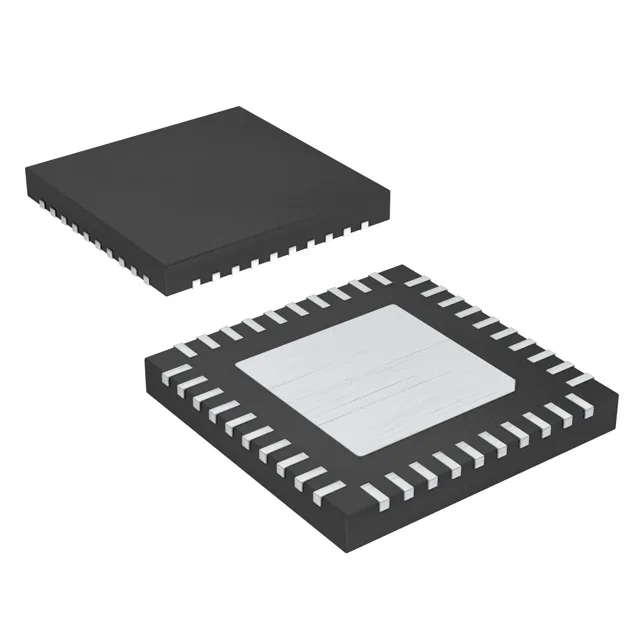
Active production, automotive-qualified dual buck-boost controller
The MAX16930BATLS/V+ is an active-production Analog Devices dual-output controller that steps up or steps down from a 3.5 V to 42 V supply rail — the wide input range covers 12 V nominal automotive bus with cold-crank dips and load-dump transients without an external pre-regulator.
What the key ratings mean for the BOM decision
Three outputs with two switching phases let the controller drive a dual-rail power tree — one buck for the MCU core and one buck/boost for the sensor or actuator supply — from a single IC, reducing the component count and PCB area compared to a discrete two-converter solution. The 1 MHz to 2.2 MHz switching-frequency range allows the designer to trade off inductor size against switching losses; at 2.2 MHz the external inductor and output capacitors shrink, which matters in the 40-TQFN (6x6 mm) footprint where board space is tight. Synchronous rectification is built in — no external Schottky catch diode needed, which saves a component and improves efficiency at high switching frequencies. Control features include Enable, Frequency Control, and Power Good — the PG flag simplifies the power-up sequencing handshake with the downstream MCU or SoC without a separate supervisor IC.