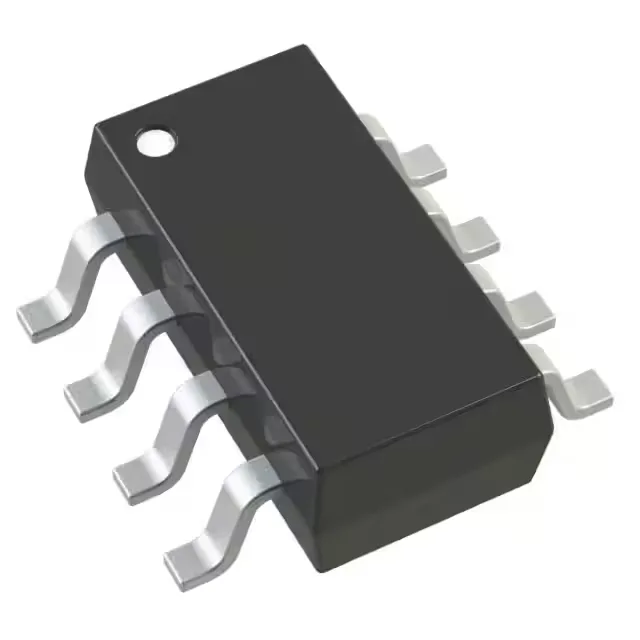
Programmable gain in a TSOT-23-8 footprint
The LTC6910-1CTS8#TRMPBF is a single-channel programmable gain amplifier (PGA) from Analog Devices, offering digitally selectable gain settings in a compact TSOT-23-8 package. With an 11 MHz gain-bandwidth product and a 16V/µs slew rate, it handles both small-signal amplification and moderate-speed waveform conditioning without sacrificing bandwidth as gain increases. The rail-to-rail output stage lets the amplifier swing within millivolts of the supply rails — useful when running from a single 5 V rail where every bit of headroom counts. The supply span of 2.7 V to 10.5 V covers common 3.3 V, 5 V, and ±5 V systems, so the same BOM position works across multiple board variants.
Gain selection and signal-chain fit
As a programmable gain amplifier, the LTC6910-1CTS8#TRMPBF sets its gain via a digital interface rather than external resistor networks — the gain code selects one of several preset values, saving board area and eliminating resistor-tolerance drift. The 11 MHz gain-bandwidth product means the closed-loop bandwidth scales inversely with gain; at a gain of 10 the small-signal bandwidth is roughly 1.1 MHz, adequate for audio, sensor conditioning, and data-acquisition front-ends. The 16V/µs slew rate sets the large-signal bandwidth ceiling — a 5 V peak-to-peak output step slews in about 300 ns, so the amplifier reproduces fast edges without slew-induced distortion up to several hundred kilohertz. The 3.5 mA supply current is moderate for this performance class; the 35 mA output current per channel drives ADC inputs or modest cable loads directly. Input offset voltage is 1.5 mV typical — acceptable for gains up to 100 in most signal-chain applications, though a precision front-end may require an auto-zero stage ahead of the PGA for microvolt-level signals.
Package, supply, and temperature grade
Housed in a TSOT-23-8 package, the LTC6910-1CTS8#TRMPBF occupies roughly 9 mm² of board area — a fit for space-constrained multichannel designs where each PGA channel sits close to its sensor. The Tape & Reel (TR) and Cut Tape (CT) packaging options suit both prototyping and production reflow. The operating temperature range is 0°C to 70°C, the commercial grade. This covers indoor equipment, test and measurement, bench instruments, and controlled-environment industrial gear, but not extended-temperature automotive or outdoor telecom enclosures without climate control.