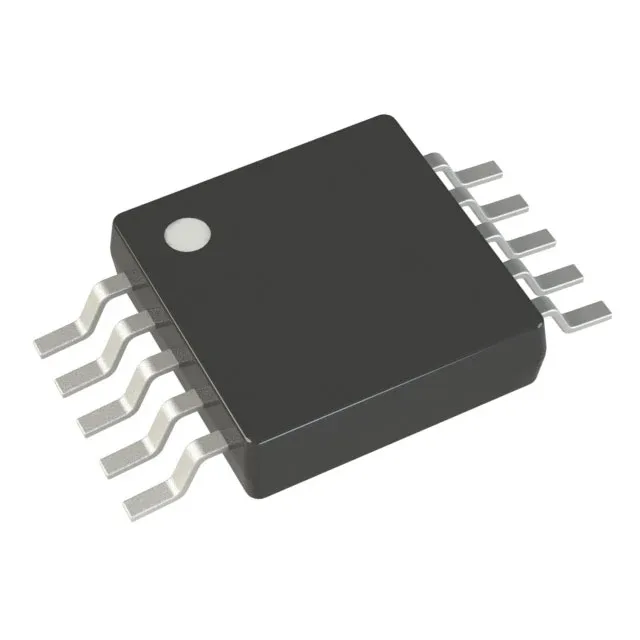
Wide-input buck controller for industrial and automotive rails
The LTC3824IMSE#TRPBF is a current-mode step-down (buck) DC/DC controller from Analog Devices, designed to regulate output voltages from input rails spanning 4V to 60V. That 60V ceiling covers 48V telecom, 24V industrial, and 12V automotive systems without an external pre-regulator. The controller drives an external N-channel MOSFET — it is not a monolithic converter — so the output current capability depends entirely on the choice of transistor and inductor. Switching frequency is programmable from 200kHz to 600kHz via a single resistor, letting you trade inductor size against switching losses.
What the 4V to 60V supply range means for your BOM
A 4V minimum input means this controller can run from a 5V rail with margin, but also from a single Li-ion cell that has dropped to 4V under load. The 60V absolute maximum on the Vcc pin handles unregulated 48V bus transients common in industrial power distribution. If your design lives on a 12V or 24V rail with occasional spikes, you do not need a separate input clamp — the controller absorbs it. The 100% duty cycle capability lets the output approach the input voltage, useful when the input sags during brownout.
No synchronous rectifier — plan for an external Schottky
This is a non-synchronous controller, meaning the low-side switch is a diode, not a second MOSFET. That simplifies the gate drive and avoids shoot-through concerns, but at low output voltages (say 3.3V from a 12V input) the diode forward drop dominates conduction loss. Budget for a Schottky rectifier rated for the peak inductor current and your output voltage — the efficiency hit versus a synchronous controller is typically 2% to 5% at full load, but the BOM cost is lower and the layout is simpler.