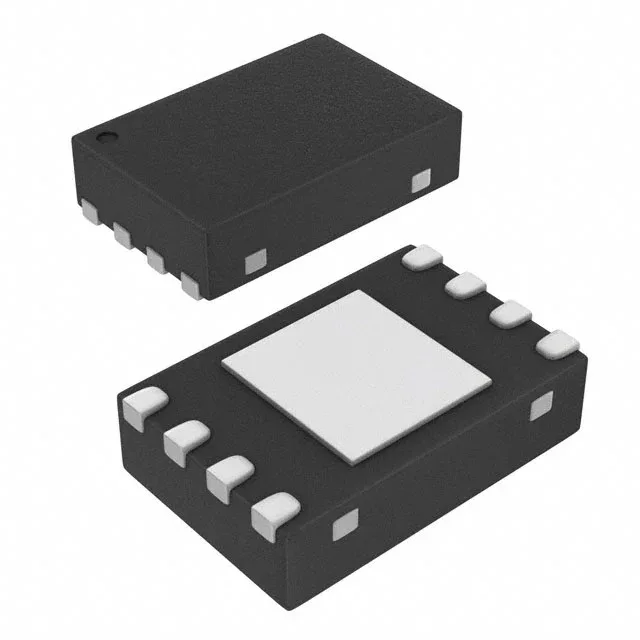
The LTC3539EDCB-2#TRPBF is a synchronous boost converter from Analog Devices, stepping up from a 0.5V minimum input to an adjustable output between 1.5V and 5.25V. The 2A switch current rating is the ceiling for the inductor peak current — it determines the maximum output power you can draw at a given input voltage. At 2 MHz switching frequency, the inductor can be physically small (typically 1 µH to 4.7 µH range), which shrinks the PCB footprint but pushes switching losses higher than a 500 kHz part would see. Because it uses a synchronous rectifier, the low-side FET replaces the usual output Schottky diode. This gains a few percent efficiency at low output voltages (under 3.3V) where the diode forward drop would eat into the margin.
The input range spans 0.5V minimum to 5V maximum. That 0.5V floor means it can start from a nearly depleted single-cell alkaline (0.9V nominal) or a Li-ion cell that has dropped to 3.0V under load. The 5V input ceiling limits the upstream rail — you cannot feed it from a 12V bus without a pre-regulator, but it is fine off a 3.3V or 5V system rail. Output is adjustable via an external resistor divider from 1.5V up to 5.25V, covering common rails for logic, sensors, or wireless modules. The single-output, positive-configuration topology is straightforward: one inductor, two feedback resistors, input and output caps. No external compensation network — the internal loop is stable for ceramic output capacitors in the 10 µF to 47 µF range. The 2 MHz switching frequency keeps the ripple amplitude low enough that a 10 µF ceramic on the output typically holds the ripple under 20 mV peak-to-peak at moderate loads.
Package, temperature grade, and field-swap reality
Housed in an 8-WFDFN with exposed pad, supplier device package 8-DFN 2x3mm. The pad is the main thermal path — without a good solder joint to the PCB copper, the junction temperature rises quickly under the 2A switch current. For field service: this is a reflow-only package. The 0.5mm pitch and exposed pad mean hand-soldering is possible with a hot-air station and flux, but a standard iron will struggle to wet the pad evenly. If you are swapping it on site without a reflow tool, budget for a pre-heated plate or hot-air pencil. The part is RoHS3 compliant — lead-free solder, no exemption issues for EU markets.
Sourcing and lifecycle — active, no obsolescence concern
The active status means lead times are typically within standard semiconductor supply windows — no broker premium unless spot shortages arise.