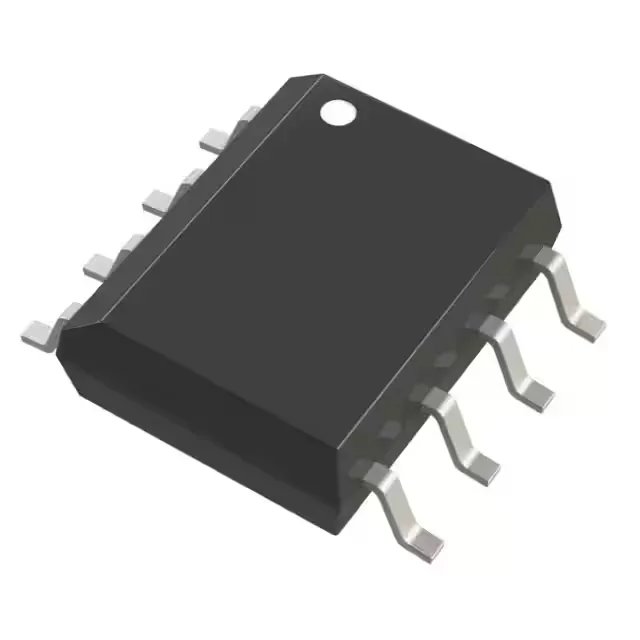
What this charge pump does on your board
The LTC1514IS8-3.3#PBF is a switched-capacitor voltage converter from Analog Devices that can step an input up or down to a fixed 3.3 V output. It uses a charge pump topology — no inductor needed — switching at 650 kHz to keep external capacitors small. The single output delivers up to 50 mA, enough to power a low-current 3.3 V rail from a battery or a 5 V bus that dips below regulation. The input range spans 2 V to 8 V, so it can start from a nearly depleted lithium cell and survive a 5 V supply that overshoots. The positive output is fixed at 3.3 V — no resistor divider needed, but also no adjustability. No synchronous rectifier is built in, so at light loads the efficiency is dominated by the diode forward drop; pick a Schottky with low Vf if you're counting milliwatts.
Package and temperature grade for the build
The supplier device package is listed as 8-SO, which matches the SOIC-8 footprint. The part ships in a tube — not tape-and-reel — so if you're feeding a pick-and-place line, plan on tube feeders or a bulk-to-tape conversion. RoHS3 compliant, so no conflict with EU or California regulatory requirements.