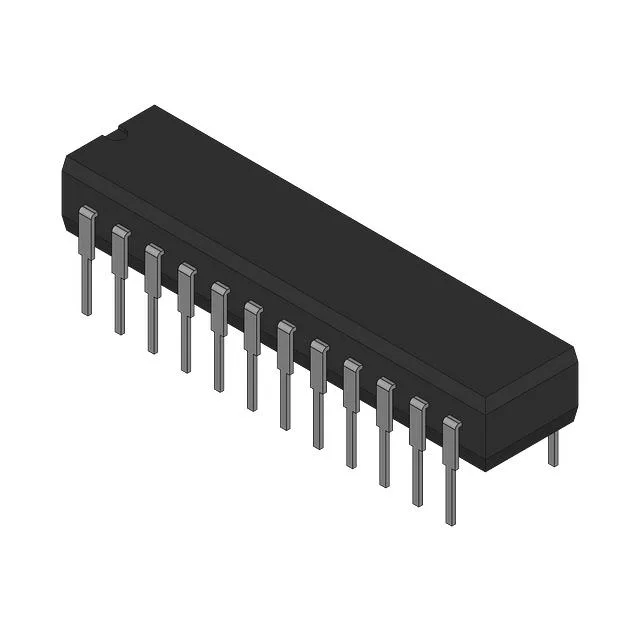
12-bit SAR ADC in a through-hole DIP — still active, still specified
The LTC1272-3CCN#PBF is a 12-bit successive-approximation-register (SAR) ADC from Analog Devices, sampling at 250k samples per second on a single-ended input. It runs on a single 5V supply for both analog and digital rails, with an internal reference — no external reference IC needed on the board. The 24-pin DIP package (0.300-inch body) is through-hole, so it fits legacy sockets, protoboards, and low-volume builds where rework is manual. Bulk packaging means no reel or tape — you get tubes or trays, which is fine for kitting but means pick-and-place needs a tube feeder or manual load.
Sampling rate and resolution — what the 250k SPS buys you
At 250k SPS, the LTC1272-3CCN#PBF digitizes signals up to roughly 125 kHz bandwidth (Nyquist limit). For a data-acquisition system scanning 16 channels at 15.6 kHz each, this part keeps up without aliasing — provided the anti-alias filter is set correctly. The SAR architecture gives no pipeline delay, so sample-to-sample timing is deterministic for multiplexed inputs. The parallel interface outputs 12 bits on 12 data lines plus a conversion clock — it ties directly to a microcontroller's parallel port or an FPGA without serial deserialization. The 1:1 S/H-to-ADC ratio means the sample-and-hold captures the input voltage for one conversion cycle, then the ADC converts; no overlapping samples.
Temperature grade and board-fit constraints
No industrial or automotive extension; if the ambient on the board exceeds 70°C, the accuracy and linearity are not guaranteed. The 24-PDIP footprint is 7.62 mm wide (0.300 inch), standard 0.100-inch pitch. It needs a 0.6 mm to 0.8 mm drill for the through-hole pins. The package height is roughly 4 mm above the board, so it fits under most card guides and enclosure lids without clearance issues.
Sourcing and lifecycle — active, no end-of-life pressure
The part is quoted through independent distribution; an RFQ is the next step.