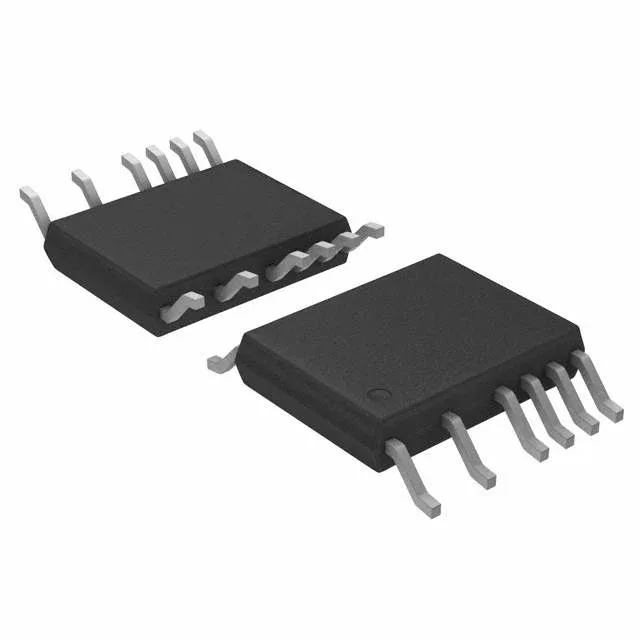
Package and rework story — 16-MSOP
The LT3748IMS#TRPBF lives in a 16-MSOP package (16-TFSOP, 3.00 mm width, 12 leads populated). That's a 0.65 mm pitch typical for this family — fine enough that a standard iron tip can handle it, but the exposed pad underneath needs a hot-air or hot-plate reflow to wet properly. The 12-lead count means the outer pins are spaced comfortably; pin 1 is notched on the package top, so orientation is clear under a loupe. Will it survive the hot air? Yes — the MSOP body is low-profile and the die attach is robust, but preheat the board to 100°C before hitting it with the nozzle to avoid lifting the pad on the opposite side.
What the wide input range buys you
Supply voltage range is 5V to 100V (Vcc/Vdd). That's a 20:1 ratio — it starts from a standard 5V rail and survives up to a 100V industrial bus without an external pre-regulator. For a flyback topology, the input range directly sets the transformer turns ratio and the MOSFET Vds stress. At 100V input, a 200V-rated primary MOSFET gives enough headroom for the reflected voltage and leakage spike. The controller's own Vcc pin draws from the same rail, so no auxiliary winding is needed for startup bias below 100V.
Flyback topology with isolation — the so-what
This is a flyback controller (step-up/step-down, single output, transistor driver). The output is 'isolation capable' — the controller drives a primary-side MOSFET, and the feedback is sensed from the primary-side auxiliary winding, not an optocoupler. That means the isolation barrier is in the transformer itself, and the secondary-side regulation is achieved through the transformer's winding coupling. No optocoupler means no CTR degradation over temperature or age, but the cross-regulation accuracy depends on the transformer design — expect 5-10% load regulation on the secondary without a post-regulator. The single output phase and no synchronous rectifier keep the BOM count low, but at the cost of efficiency at high output currents (expect 80-85% typical for a 5V/2A design).
Temperature grade — industrial, not automotive
Operating temperature is -40°C to 125°C junction. That's the full industrial band — suitable for outdoor telecom cabinets, motor drive enclosures, and engine bay-adjacent electronics that see 105°C ambient. The 125°C TJ limit means the junction-to-ambient thermal resistance of the MSOP package (about 180°C/W without airflow) limits power dissipation to about 0.7W at 85°C ambient — fine for a controller, but the external MOSFET will be the thermal bottleneck.
Sourcing posture — active, reeled for production
Lifecycle status is active per the manufacturer. The TRPBF suffix means Tape & Reel packaging — 2,500 pieces per reel typical for MSOP-16. This is the production-friendly format for pick-and-place; the Cut Tape variant is also listed for prototype quantities. The LT3748EMS#TRPBF (industrial temp, same reel format) is a functional peer — the 'I' vs 'E' suffix denotes different temperature grades, so verify the operating range before substituting. The tube-packed variants (LT3748IMS#PBF, LT3748EMS#PBF) are the same die but in different shipping media — not a functional difference, just a handling preference.