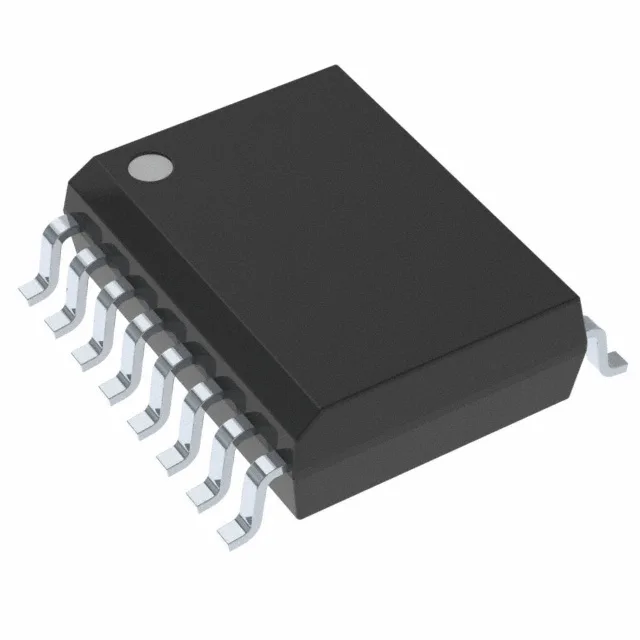
Analog Devices ADUM6403ARWZ — Digital Isolators

ADUM6403ARWZ IsoPower Digital Isolator, 5000Vrms, 1Mbps

MPNADUM6403ARWZ
End of Life

Analog Devices ADUM6403ARWZ, IsoPower iCoupler series, quad-channel general-purpose digital isolator with integrated isolated DC-DC converter, 1Mbps data rate, 5000Vrms isolation, 25kV/µs CMTI, unidirectional 1/3 input/output, 3V to 5.5V supply, -40°C to 105°C, 16-SOIC package.

$15.76Ref. price · indicative, final on quote
Packaging16-SOIC (0.295", 7.50mm Width)
StockContact for availability
MOQ1 pcs
  • 100% new & originalTraceable channels only — no refurbs, no pulls, no remarked parts.
  • Date & lot codes on quoteStated per line before you commit; label photos on request.
  • MSL-compliant ESD packingMoisture-sealed bags with indicator cards; reels photo-verified.
  • PayPal buyer protectionPay by T/T, PayPal or Payoneer — card payments covered end to end.

Specifications

ADUM6403ARWZ Technical Specifications
ParameterValue
TypeGeneral Purpose
SeriesIsoPower®, iCoupler®
Channel typeUnidirectional
Mounting typeSurface Mount
Voltage3V ~ 5.5V
Voltage - isolation5000Vrms
Isolated powerYes
Operating temperature-40°C ~ 105°C
Pulse width distortion40ns
PackageTube
Data rate1Mbps
TechnologyMagnetic Coupling
Case16-SOIC (0.295\", 7.50mm Width)
Number of channels4
Inputs - side 1/Side 21/3
Rise (Fall time)2.5ns, 2.5ns
Propagation delay tpLH (tpHL)100ns, 100ns
Common mode transient immunity25kV/µs

Product details

The ADUM6403ARWZ is a quad-channel digital isolator from Analog Devices' IsoPower and iCoupler series that integrates an isolated DC-DC converter on-chip. That means it can provide a regulated, isolated output voltage from its own internal oscillator and transformer — no separate isolated power module needed on the secondary side. The part is rated for 5000Vrms isolation and a minimum common-mode transient immunity of 25kV/µs, which puts it squarely in the industrial motor-drive and inverter class where high-voltage transients are the norm. The 1Mbps data rate with 100ns max propagation delay is fine for SPI, UART, and general-purpose GPIO isolation, but not for high-speed interfaces like CAN (typically 1Mbps but tighter timing) or full-speed USB.

Channel direction and supply voltage — getting the fit right

The channel arrangement is 1 input on Side 1 (the primary side) and 3 inputs on Side 2 (the isolated side). The supply range is 3V to 5.5V on both sides, so 3.3V or 5V logic rails work without a separate level shifter — but both sides must be powered within that window; the IsoPower converter generates its own isolated rail internally, not from an external secondary supply.

Package and thermal handling

Housed in a 16-SOIC wide-body package (7.50mm width) with surface-mount termination. The IsoPower converter runs its own internal switching at a few hundred kilohertz, so the usual SOIC-16 thermal dissipation applies — no exposed pad, so the junction-to-ambient path is through the leads and board copper. For continuous operation near 105°C ambient, ensure adequate copper pour on the secondary side to spread the converter's dissipation.

Frequently asked questions

Where can I buy ADUM6403ARWZ and get a price?

Submit an RFQ to receive a firm price and lead time.

Does ADUM6403ARWZ provide isolated power on the secondary side?

Yes, the ADUM6403ARWZ integrates an IsoPower isolated DC-DC converter that generates a regulated, isolated output voltage on the secondary side — no external isolated power module required.

What is the difference between ADUM6403ARWZ and ADUM6402ARWZ?

Both are quad-channel IsoPower digital isolators with 5000Vrms isolation, 1Mbps data rate, and the same package. The key difference is the input/output channel direction: the ADUM6403ARWZ has a 1/3 split (1 input on Side 1, 3 inputs on Side 2), while the ADUM6402ARWZ has a 2/2 split. Choose based on how many signals cross the barrier in each direction.

Can ADUM6403ARWZ be used for CAN bus isolation?

The ADUM6403ARWZ has a 1Mbps data rate with 100ns propagation delay and 40ns pulse-width distortion. While CAN bus runs at up to 1Mbps, the timing margins are tight — the 100ns delay and 40ns distortion may not meet the loop-delay requirements of a standard CAN transceiver interface. For CAN isolation, consider a dedicated CAN isolator or a higher-speed digital isolator with lower propagation skew.