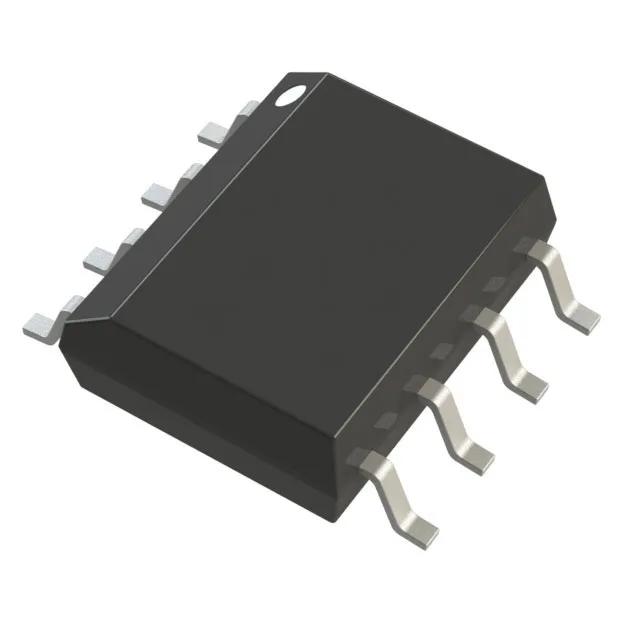
Single-channel isolated gate driver with 3000Vrms isolation
It delivers 4A peak output current across a 3000Vrms isolation barrier, with a propagation delay of 62ns max and common-mode transient immunity of 50kV/µs minimum. The output supply range is 11.1V to 18V, making it suitable for driving IGBTs and MOSFETs in motor drives, solar inverters, and industrial power supplies.
4A peak drive and 62ns propagation delay — timing budget for dead-time
The 4A peak output current is enough to drive the gate charge of medium-power IGBTs and MOSFETs without excessive Miller plateau dwell. The 62ns max propagation delay (both tpLH and tpHL) sets the lower bound on dead-time insertion in half-bridge and full-bridge topologies — a 62ns mismatch between channels in a dual-driver design would eat into the dead-time margin, but this single-channel part avoids that skew. Rise and fall times are 12ns typical, which keeps switching losses predictable at moderate frequencies.
50kV/µs CMTI — survives fast dv/dt in motor-drive and inverter environments
Common-mode transient immunity of 50kV/µs minimum means the output state does not glitch when the ground reference jumps at several tens of kilovolts per microsecond — exactly what happens across the isolation barrier in a motor-drive phase leg or a solar inverter switching node. This rating is the one that separates a gate-driver isolator from a generic digital isolator in high-side drive applications.
Active lifecycle, ROHS3, agency approvals
It is ROHS3 compliant and holds CSA, UR, and VDE safety approvals. The 8-SOIC package is surface-mount, 0.154" body width, suited for standard reflow assembly.