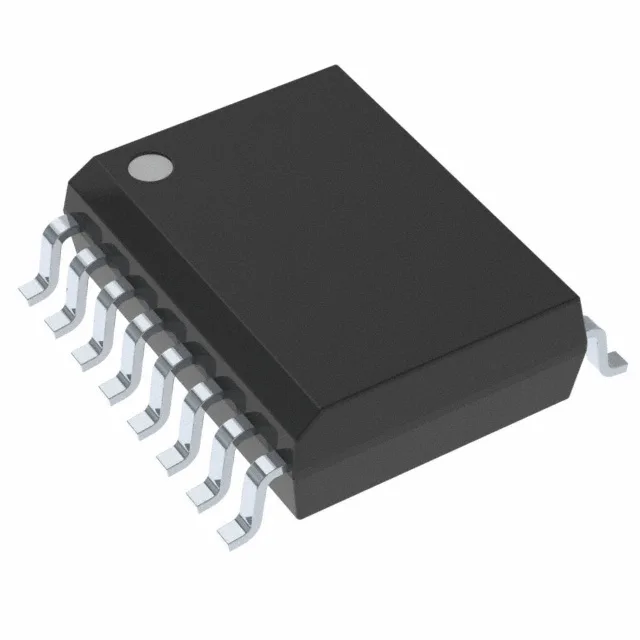
Three-channel digital isolator with reinforced isolation
The ADI ADUM231E0BRWZ is a 3-channel, unidirectional digital isolator from the iCoupler® family, built around magnetic coupling technology. It delivers 5000 Vrms isolation in a 16-SOIC wide-body package, with a data rate of 150 Mbps and propagation delay of 13 ns max each way. The 2/1 input split (two channels on side 1, one on side 2) suits applications like isolated SPI, UART, or general-purpose signal isolation where the majority of signals cross from the controller side to the peripheral side.
The 5000 Vrms isolation rating qualifies this part for reinforced isolation in mains-connected industrial equipment, motor drives, and medical systems where safety standards demand a minimum 5 kV barrier. A part with lower CMTI would glitch or latch, corrupting data; this one holds the line. The 13 ns propagation delay and 2.5 ns rise/fall times keep the timing budget tight enough for 150 Mbps serial links, but the fast edges also mean the PCB layout needs care — keep the isolation barrier clear of copper pour and route the signal traces short to avoid ringing.
That simplifies the power rail design and saves board area.