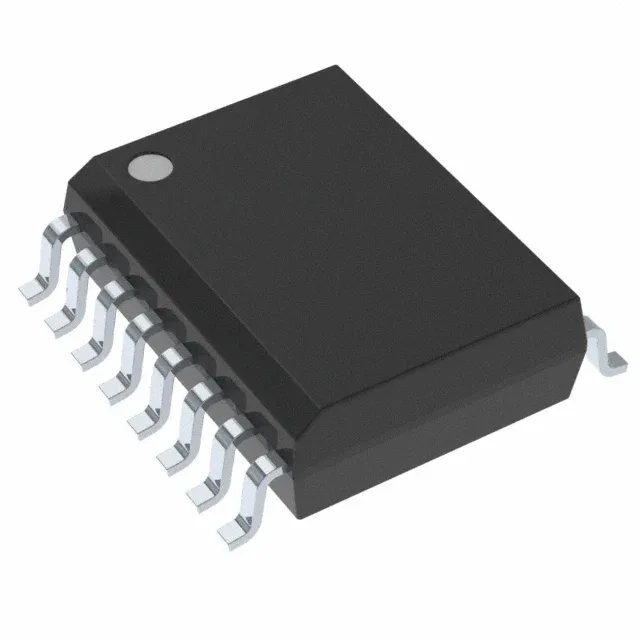
Three-channel unidirectional isolation at 150 Mbps
The Analog Devices ADUM230D0BRWZ is a three-channel, unidirectional digital isolator from the iCoupler family, built on magnetic coupling technology. It delivers a data rate of 150 Mbps per channel, with 5000 Vrms isolation between the input and output sides.
At 150 Mbps, this isolator handles SPI clock rates up to 75 MHz (half-duplex) or full-duplex 150 Mbps data streams without bit errors. The 13 ns max propagation delay (tpLH / tpHL) and 3 ns max pulse-width distortion keep the signal edges clean enough for most high-speed serial links.
Package and footprint — 16-SOIC wide-body
The 16-pin footprint is common across many iCoupler devices, so a board layout designed for this part can often accommodate a pin-compatible sibling if supply shifts. No external isolated power supply is needed — the part derives its isolation barrier power from the input-side supply, so you only need to provide 1.7V to 5.5V on each side separately.
Temperature range and common-mode transient immunity
The 75 kV/µs minimum common-mode transient immunity means it rejects fast voltage spikes across the isolation barrier — a common failure mode in motor-drive and inverter applications where switching transients couple into the signal path.