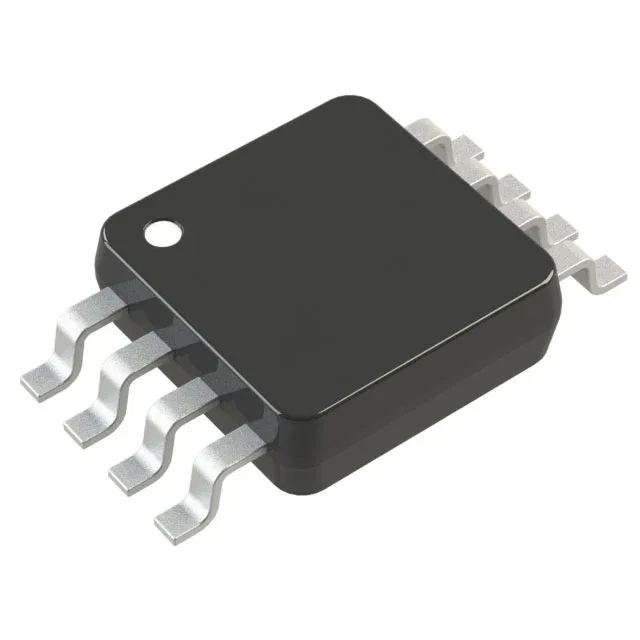
Package and integration story
The ADA4661-2ARMZ comes in an 8-MSOP package (3.00 mm width), surface-mount, delivered in a tube. The MSOP-8 footprint is a common 0.65 mm pitch layout — the same as many industry-standard dual op-amps — so the board layout is straightforward if you are replacing an existing part. The tube delivery means your pick-and-place feeder setup needs to handle tube-fed parts rather than tape-and-reel; if your line is set up for tape, factor in a tube-to-tape conversion or order an alternative tape-and-reel variant if one exists.
What the key ratings mean for your BOM
The 30 µV typical input offset voltage and 0.5 pA input bias current make this a precision CMOS amplifier — the offset is low enough that most designs won't need external nulling, and the bias current is negligible even with high-impedance sources like photodiodes or pH probes. The 4 MHz gain-bandwidth product and 2.1 MHz -3 dB bandwidth set the small-signal frequency range: at a gain of 10, expect a closed-loop bandwidth around 400 kHz, which covers many sensor-conditioning and audio applications. The rail-to-rail output means the output swings within a few millivolts of the supply rails — critical in low-voltage single-supply designs (3 V minimum supply span,) where every millivolt of headroom matters. The 220 mA output current per channel is unusually high for a CMOS op-amp; it can drive headphones, multiple ADC inputs, or long cables directly without an external buffer. Supply current is 630 µA per channel — for a dual op-amp that is 1.26 mA total, low enough for battery-powered or multi-channel systems. The wide supply span from 3 V to 18 V covers both 3.3 V and 5 V logic rails as well as industrial 12 V or 15 V supplies, so the same part can be used across different board voltages without a separate regulator. The slew rate of 2 V/µs is moderate for a precision amp — it limits the full-power bandwidth to about 100 kHz at 10 V output swing. If your signal has fast edges (e.g., square waves above 100 kHz), the output will slew-limit and distort; for audio or sensor signals below that, it is fine.
Temperature grade and deployment
Rated for -40°C to 125°C, this is an industrial/automotive temperature grade. The part can sit under the hood of a vehicle, in an outdoor enclosure, or on a factory floor without derating. The 125°C upper limit means the junction temperature can reach that level under load — check the thermal resistance of the 8-MSOP package if your ambient is near 125°C and the output is driving heavy current.