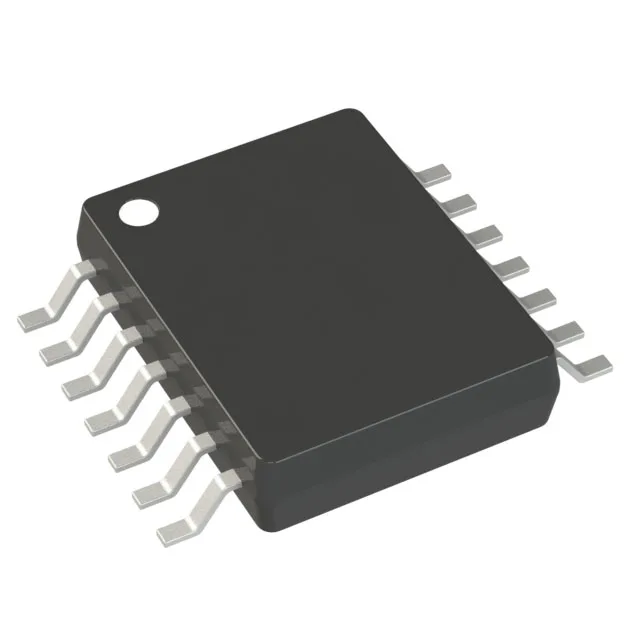
The AD8402ARUZ100-REEL: ROHS3 compliant, so it passes EU material restrictions without an exemption — no separate waiver documentation needed for the BOM.
100k, 256 taps, SPI — the BOM-fit parametrics
100 kΩ end-to-end resistance with 256 wiper taps per circuit — the resolution is 390 Ω per step, which sets the smallest adjustable increment in a voltage-divider or programmable-gain application. Two independent potentiometer circuits in the same 14-TSSOP package — one chip replaces two single-channel digipots, saving board area and reducing the SPI chip-select count.
Linear taper means the wiper resistance changes proportionally with the digital code — the resistance between wiper and B terminal is (code/256) × R_AB. This is the standard for programmable voltage dividers and op-amp gain-setting; it is not a logarithmic (audio) taper. ±30% tolerance on the 100 kΩ end-to-end resistance means the actual R_AB can range from 70 kΩ to 130 kΩ. The ratiometric accuracy (step-to-step matching) is tighter than the absolute tolerance, so the divider ratio is more repeatable than the absolute resistance. If the BOM needs a precise absolute resistance, plan for a calibration step or use the part in a ratiometric configuration. Wiper resistance is 200 Ω typical — this adds in series with the selected tap resistance and matters most at the lowest codes where the wiper-to-B resistance is small.
Industrial temperature grade and package
The 500 ppm/°C temperature coefficient means the resistance drifts by 50 Ω per 100°C, which is acceptable for most trimming and calibration loops but may need derating in precision references. 14-TSSOP package with 0.65 mm pin pitch — the standard fine-pitch SOIC footprint. The supplier device package is also 14-TSSOP, so no footprint mismatch between the order code and the physical part.
Cross-reference notes — peer variants
The AD8402ARUZ100 (tube packaging) is the same die and electrical spec — the only difference is the shipping medium. The AD8402ARZ100-REEL is also electrically identical but uses a different package suffix (ARZ vs ARUZ), which may indicate a different lead-frame or plating; confirm the package drawing before substituting.