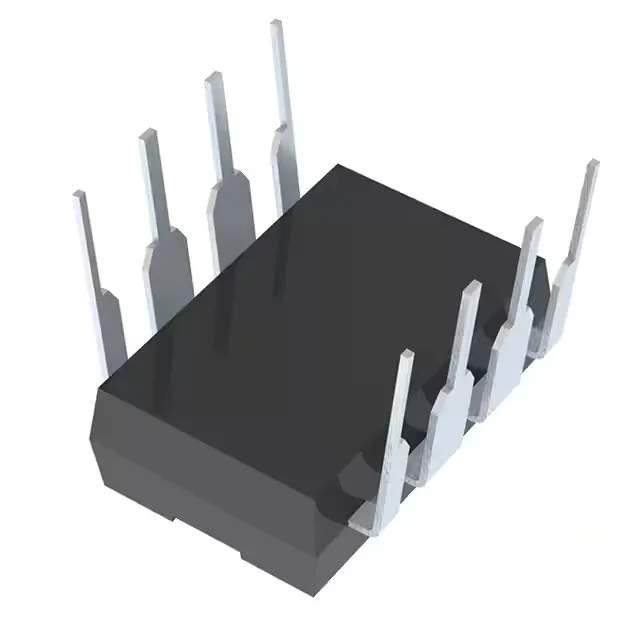
The AD781JNZ is a single-channel sample-and-hold amplifier from Analog Devices, packaged in an 8-pin DIP (0.300" body width) for through-hole mounting. It delivers a -3 dB bandwidth of 4 MHz, making it suited for capturing analog signals up to that frequency before presenting them to an ADC. Operating from a supply span of 21.6 V to 26.4 V (min to max) and drawing 4 mA quiescent supply current, it integrates into ±15 V or single 24 V rail designs typical of industrial data-acquisition front-ends. The 50 nA input bias current and 5 mA output drive per channel define its interface to preceding signal-conditioning stages and the downstream converter input.
Package and mounting — board-fit note
Housed in an 8-DIP (0.300", 7.62mm) package with a through-hole mounting style, the AD781JNZ is supplied in tubes. The 8-PDIP footprint is a standard 0.100-inch pitch, 0.300-inch row spacing — the same as legacy DIP-8 op-amp and comparator sockets, so it drops into existing through-hole layouts without a board spin. No exposed pad or thermal slug — the PDIP's junction-to-ambient thermal resistance is higher than surface-mount equivalents, so the 4 mA supply current and 5 mA output current produce minimal self-heating within the commercial temperature band, but forced airflow is advisable if the ambient approaches 70°C and the output is continuously sourcing 5 mA.
Lifecycle and compliance status
It is also ROHS3 compliant, meaning it meets the latest EU RoHS exemption limits without lead in solder or plating — important for CE-marked equipment and for avoiding re-qualification if your BOM is subject to ROHS3 enforcement.
Peer comparison — AD712KNZ and AD625KNZ
The AD781JNZ is a sample-and-hold, not a general-purpose op-amp, so the AD712KNZ is not a direct pin-for-pin replacement without circuit redesign. The AD625KNZ is an instrumentation amplifier with 25 MHz bandwidth and 20 nA input bias — a different signal-chain role entirely.