Active production — what that means for a BOM line
The AD741JN: It is RoHS non-compliant, which matters for any BOM that requires lead-free assembly — confirm your board's soldering profile and regulatory requirements before committing the line.
Slew rate and bandwidth — the signal ceiling
A 0.5 V/µs slew rate paired with a 1 MHz -3 dB bandwidth sets the large-signal response: a 10 V output step slews in 20 µs, which limits the amplifier to signals below roughly 80 kHz at full swing before slew-induced distortion appears. For small-signal applications the 1 MHz gain-bandwidth product governs the closed-loop gain — a gain-of-10 stage has a 100 kHz small-signal bandwidth, adequate for audio, sensor conditioning, and control loops that do not need fast edge rates.
Input offset and bias — DC accuracy at the front end
The 1 mV typical input offset voltage and 40 nA input bias current are standard for a general-purpose bipolar op-amp — the offset contributes a DC error of 0.04 % at a 2.5 V reference, and the bias current into a 10 kΩ source resistor adds another 400 µV of offset. These figures suit circuits where the signal is in the millivolt range or higher; for microvolt-level front ends the bias current and offset drift over the 0 °C to 70 °C range become the dominant error terms.
Supply range and output drive — rail headroom matters
The 10 V to 44 V supply span means the AD741JN runs on common ±5 V, ±12 V, or ±15 V rails without needing a separate regulator — the 44 V ceiling covers industrial ±15 V supplies with margin. Output current is rated at 25 mA per channel, enough to drive a 600 Ω load to ±10 V swing or to source the input of a successive ADC without an external buffer.
Package and mounting — board integration
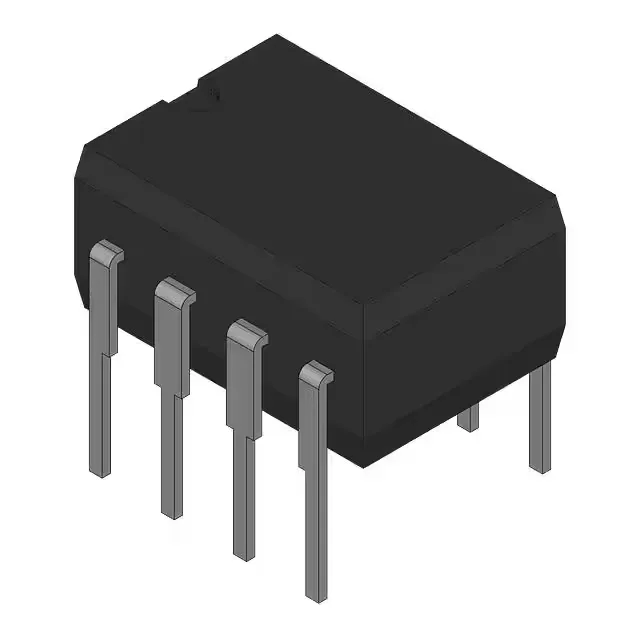
The 8-pin DIP (0.300" width, 7.62 mm row spacing) in a through-hole PDIP-8 package is a breadboard-friendly footprint that drops into standard 0.100" pitch sockets or solders directly into plated through-holes. Single-circuit (1 op-amp per package) means one AD741JN per signal channel — a dual-channel design needs two devices, whereas a dual op-amp like the AD706JNZ fits the same function in one package.
Sourcing posture — quoting to order
The 2.2 mA supply current per amplifier keeps the thermal budget low in multi-channel boards — no special heatsinking needed even in a densely populated DIP array.