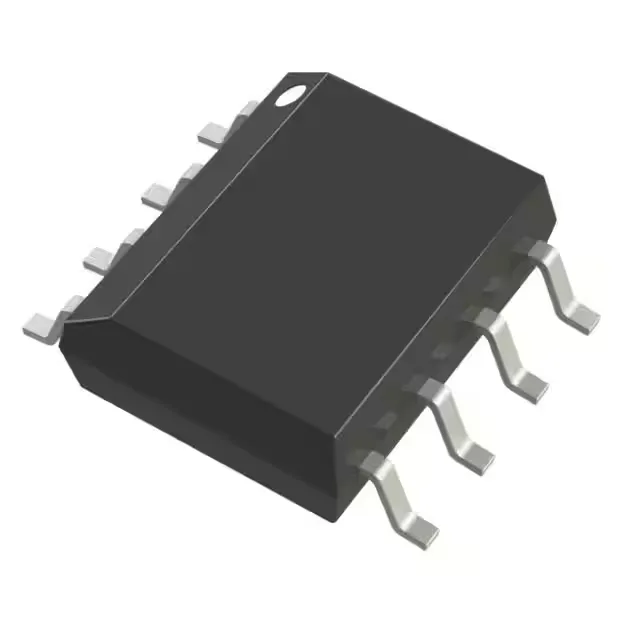
Package and board integration — 8-SOIC, no surprises
The AD648JRZ-REEL7 ships in an 8-SOIC package (0.154-inch body width, 3.90 mm) with the standard JEDEC footprint — the same land pattern as any generic SOIC-8 op-amp. No exposed pad, no thermal via required; the board layout is a drop-in for existing dual-op-amp positions. The -REEL7 suffix means it is supplied on a 7-inch tape-and-reel (a full reel quantity, typically 1000 pieces), not a cut tape or tube. The die and marking are identical to the AD648JRZ bulk-tube variant — only the packaging reel differs.
Parametric fit — low-power JFET precision for signal conditioning
Two JFET-input amplifiers in one 8-SOIC, each drawing 340 µA supply current. The 1 MHz gain-bandwidth product and 1.8 V/µs slew rate cover audio-band filtering, sensor buffering, and control-loop compensation — the bandwidth is adequate for signals up to roughly 100 kHz before open-loop gain drops below 20 dB. Input bias current is 5 pA typical, and input offset voltage is 750 µV maximum. For a 10 kΩ source impedance, the bias current contributes 50 nV of DC error — negligible in most precision circuits. The offset is moderate; if sub-100 µV nulling is required, consider a trim network or a zero-drift amplifier. Output drive is 15 mA per channel, enough to swing into a 2 kΩ load to ground or drive a 100 pF capacitive load without oscillation — typical for driving ADC inputs or second-stage filters.
Supply range and temperature grade — commercial-only envelope
Operates from a 9 V to 36 V total supply span — that is ±4.5 V to ±18 V with split rails, or a single 9 V to 36 V supply. The 0°C to 70°C commercial temperature range limits this part to indoor, temperature-controlled equipment; it is not rated for industrial or automotive ambient extremes.
Sourcing and lifecycle — active, no end-of-life clock
No direct functional equivalent from other manufacturers is listed. The closest Analog Devices peer by function is the AD711JRZ-REEL7 (single, 4 MHz) or the AD713JRZ-16-REEL (quad, 4 MHz) — both are faster but draw more supply current and are not pin-compatible.