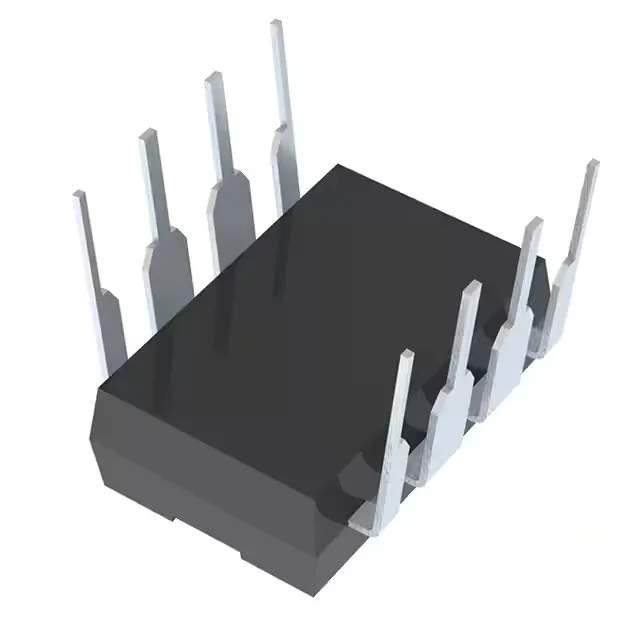
Through-hole differential amp for precision signal conditioning
The AD626ANZ is a single-circuit differential amplifier in an 8-pin DIP package (0.300" body width, 7.62 mm pitch) — the through-hole footprint mates with standard 0.100" prototyping grids and socket strips, making it a natural fit for breadboard validation or legacy PCB layouts that avoid surface-mount rework. Its differential topology rejects common-mode noise on the input lines, which matters when the signal source is remote from the ADC or controller — think bridge sensors, current-shunt monitors, or any twisted-pair run inside a panel. Supply span runs from 2.4 V single-supply up to ±6 V dual-supply, so the same part works in a 3.3 V microcontroller system or a ±5 V industrial analog front-end.
Bandwidth and slew rate set the signal ceiling
The -3 dB bandwidth of 100 kHz and slew rate of 0.22 V/µs together define the large-signal response: a 5 V peak-to-peak output step slews in about 23 µs, limiting the usable frequency to well below 100 kHz for full-swing signals. Input offset voltage is trimmed to 50 µV typical, which keeps the DC error below 0.01% on a 500 mV shunt signal without external nulling — the 8-DIP package does have offset-null pins (pins 1 and 8) if tighter trim is needed. Output can source or sink 12 mA, enough to drive a 2.5 V reference into a 200 Ω load or feed the input of a successive-approximation ADC without an external buffer.
Industrial temperature range and active lifecycle
Rated for -40°C to +85°C ambient, the AD626ANZ covers the industrial temperature envelope — suitable for factory-floor sensor interfaces, environmental monitoring, and automotive cabin electronics that see under-hood-like thermal cycling. The 1.5 mA quiescent supply current keeps the thermal footprint low in the 8-DIP package — no heatsink needed even at 85°C ambient, as long as the output current stays within the 12 mA rating.
Board integration and supply routing
The 8-DIP package with 0.300" row spacing fits standard 0.100" pitch sockets or wave-solder through-hole pads — no special footprint beyond the 8-pin DIP land pattern. Supply decoupling should follow the usual 0.1 µF ceramic close to pins 4 (V-) and 7 (V+) — the 100 kHz bandwidth means the amplifier will amplify power-supply ripple at that frequency, so a low-inductance bypass cap is non-negotiable. Tube packaging (the standard through-hole anti-static tube) delivers 50 parts per tube — no reel or tape, so pick-and-place requires a tube feeder or manual insertion.