22.5mV/°C transfer function and what it means for your BOM
The AD22100STZ outputs an analog voltage that scales linearly at 22.5mV per degree Celsius — a 25°C ambient reads 0.5625V, while a 100°C target reads 2.25V. This ratiometric output lets a standard ADC input capture the full -50°C to 150°C span without external gain staging, as long as the ADC reference tracks the sensor's 4V to 6.5V supply rail. Accuracy is specified as ±2°C typical at 25°C, widening to ±4°C across the full -50°C to 150°C range. For a system that budgets ±3°C total error, this sensor consumes most of the allocation at the extremes — a one-point calibration at the operating midpoint tightens the effective tolerance to the typical band.
TO-92-3 package and board-fit constraints
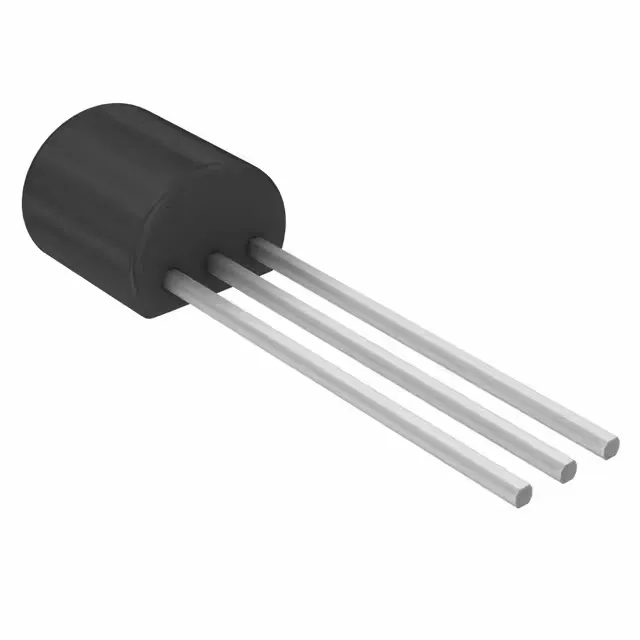
The through-hole TO-92-3 (TO-226AA) package has a 2.54mm pin pitch and a 4.5mm body width — it drops into a standard 0.1-inch breadboard or PCB footprint. The three pins are supply, ground, and output; no external compensation capacitor is required, but a 0.1µF bypass near the supply pin filters coupled noise from the board's switching rails. Bulk packaging means the parts ship in tubes or trays, not tape-and-reel — a pick-and-place machine handling through-hole parts needs a tube feeder or tray shuttle. For hand-assembly or rework, the TO-92 leadframe solders easily with a standard iron at 350°C; the plastic body withstands brief exposure to 260°C peak reflow per JEDEC J-STD-020.
Supply rail and output interface
Operating from 4V to 6.5V, the AD22100STZ runs directly off a 5V regulated rail or a 3.3V-to-5V boost — but not off 3.3V logic supplies. The analog output swings from 0.25V at -50°C to 4.75V at 150°C, so a 5V ADC with a 0V-to-5V input range captures the full span without level shifting. Local sensing means the die temperature tracks the PCB or ambient near the package — not a remote thermocouple or diode. Mount the sensor close to the heat source (a power transistor, processor, or ambient air path) and keep the output trace short to avoid parasitic capacitance loading the 22.5mV/°C slope.
Active lifecycle and compliance documentation
For a design starting today, the active status means the part is available through authorized distribution channels without allocation risk.