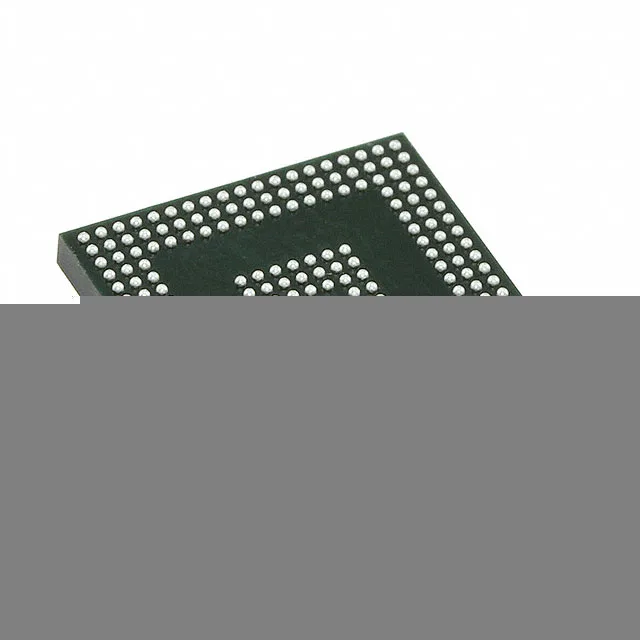
Logic fabric and memory — what 52k LEs and 2.7 Mbit block RAM buy you
The XC7S50-1CSGA324I packs 52160 logic elements (cells) in a Spartan-7 fabric — that is enough LUT and flip-flop density to implement a 32-bit RISC-V core with a small cache, a video scaler, or a 4-port Gigabit Ethernet switch without external logic. The 2764800 total block RAM bits (2.7 Mbit) let you hold a 640×480 VGA frame buffer at 8-bit depth or a 1024-deep packet FIFO for a 1 GbE datapath, keeping the design single-chip for latency-critical control loops. 4075 CLB slices give the routing granularity for pipelined datapaths — a 16-tap FIR filter or a 128-point FFT fits without consuming all the local interconnect.
Package and board integration — 324-ball CSGA at 0.8 mm pitch
The 324-ball CSGA (Chip-Scale BGA) measures 15×15 mm with a 0.8 mm ball pitch — the fan-out pattern fits on a 6-layer PCB with microvias; a 4-layer board requires blind vias for the inner rows. 210 user I/O available from the 324-ball array — the I/O-to-ball ratio is high enough that most designs populate the full I/O ring, so the decoupling capacitor placement on the back side of the BGA footprint needs careful planning to avoid blocking via-in-pad. Surface-mount assembly with a tray carrier — the package is moisture-sensitive; the MSL level is not listed in the spec record, so assume Level 3 (168-hour floor life) as the Spartan-7 default and schedule the bake if the reel exposure exceeds that window.
Supply rails and temperature grade
Core supply is 0.95 V to 1.05 V — the 100 mV tolerance means the regulator's DC accuracy and load transient response are the limiting factors, not the FPGA itself. A 1.0 V ±2% LDO or a switching regulator with <10 mV ripple meets the spec.