52,160 logic elements — where the Artix-7 fits
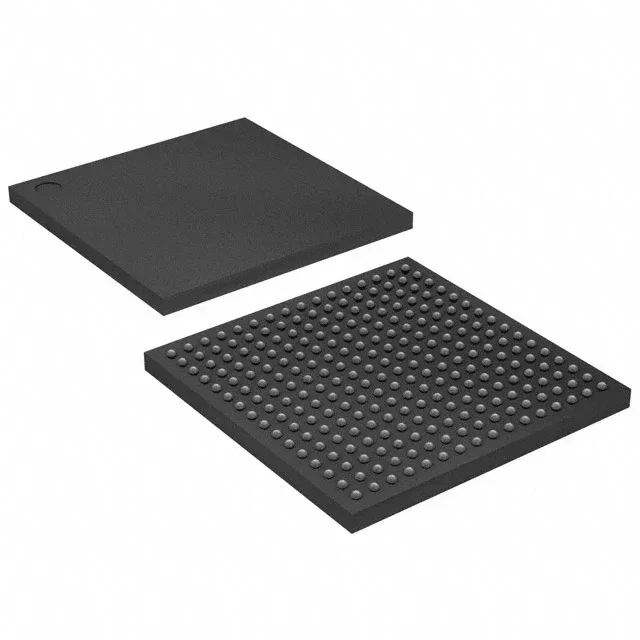
The XC7A50T-1FTG256I sits in the Artix-7 family at the 50T density tier, delivering 52,160 logic cells and 4,075 LABs/CLBs. For a mid-range FPGA this means it can absorb a soft-core processor, a few DSP slices, and a modest peripheral bus without spilling into a larger package. The 170 user I/O are brought out to a 256-ball FTBGA (17x17 mm) — a compact footprint that keeps the PCB layer count manageable on a 4- or 6-layer board, though the 0.8 mm ball pitch still demands careful fan-out on the inner rows.
2.7 Mb block RAM and the memory budget
Total block RAM is 2,764,800 bits (2.7 Mb). In practice this gives you about 180 18Kb blocks — enough for a 32-deep FIFO per I/O bank, a few line buffers for video, or a small packet buffer in a 1 GbE MAC. If your design needs more than 3 Mb of on-chip memory, the next step up in the Artix-7 line (75T) adds roughly 50% more BRAM. The core voltage supply is 0.95 V to 1.05 V — a 1.0 V nominal rail. This is the lowest voltage in the 7-series, which keeps dynamic power in check but means the power rail must be regulated within 50 mV. A standard 1.0 V LDO with 1% accuracy covers it, but a switching regulator needs good transient response to stay inside the window during logic toggling.
The 'I' suffix in the order code denotes the industrial temperature grade: operating junction temperature from -40°C to 100°C. This covers most factory-floor, outdoor telecom, and automotive under-hood (non-engine-bay) environments. At 100°C junction the static power (leakage) roughly doubles from the 25°C figure, so the thermal solution — heatsink or forced air — must be sized for the actual toggle rate, not just the logic cell count.