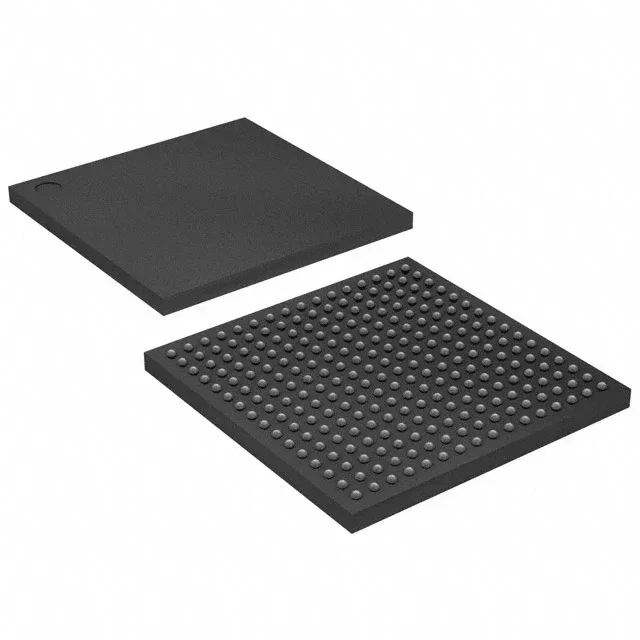
33 280 logic cells in a 17×17 mm BGA
The XC7A35T-1FTG256C is an Artix-7 FPGA packing 33 280 logic elements across 2 600 CLB slices. That puts it in the sweet spot for mid-density glue logic, sensor fusion, or motor-control co-processing where you need more than a CPLD but do not want the cost and power of a Kintex-class device. The 256-FTBGA (17×17 mm) footprint mates to a standard 4- or 6-layer PCB — the 0.80 mm ball pitch is hand-solderable with a decent iron and flux, though a hot-air station is cleaner for rework. No lab bench required if you have a stencil and a reflow skillet.
170 I/O and 1.8 Mbit of block RAM
170 user I/O on a 256-ball package means roughly 70 % of the balls are signal — plenty for a 16-bit data bus, address lines, and a handful of control signals without starving the core. The remaining balls are supply and ground, which keeps the PDN clean for the 0.95 V to 1.05 V core rail. 1 843 200 total RAM bits (about 225 KB) live in the block RAM columns — enough for a modest frame buffer, a few FIFOs, or a small lookup table. For larger data planes you would reach for the external DDR interface, but for on-chip scratch this is adequate for the logic-cell count. Temperature range is 0 °C to 85 °C junction — commercial/industrial grade. Fine for a control cabinet or lab instrument; if the board lives under a car hood or in a freezer, you need the -1I or -2I speed grade variant.