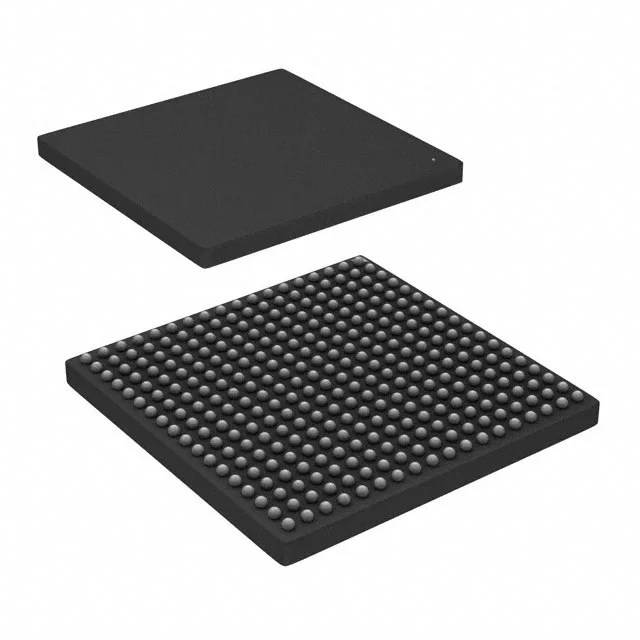
Device identity and logic fabric
The XC7A15T-2CSG325I is an Artix-7 FPGA from Xilinx, built on the 28 nm process node. It packs 16,640 logic cells distributed across 1,300 configurable logic blocks (CLBs), giving you a mid-density fabric for glue logic, sensor fusion, or motor-control state machines without the cost of a Kintex-class device. On-chip block RAM totals 921,600 bits — enough to hold a 1280×720 pixel line buffer or a 64-entry 32-bit FIFO for high-speed data staging between the fabric and external memory.
I/O and package — what fits on the board
150 user I/O are brought out to a 324-ball CSPBGA (15×15 mm) — the 0.8 mm ball pitch is a standard four-layer board fan-out; no microvia stack-up needed. The core voltage supply range is 0.95 V to 1.05 V, so the 1.0 V rail must be within ±5 % at the BGA balls, not just at the regulator output. Surface-mount only — the CSPBGA package is MSL 3 by default for this family. If the board goes through reflow without a pre-bake and the floor life is exceeded, moisture trapped under the die will popcorn the package. Check the MSL label on the reel before scheduling the line.
Temperature grade and deployment context
This covers outdoor telecom cabinets, engine-bay controllers with passive cooling, and factory-floor PLCs where the enclosure ambient hits 70°C and the FPGA self-heats another 30°C above that. The 'I' suffix in the order code signals this industrial temperature range. A commercial-grade (C) variant would stop at 85°C junction; if your thermal simulation shows the die crossing 85°C under full-tilt operation, this part keeps you inside the SOA.
Sourcing and compliance reality
No stock-holding claim — the RFQ sets the terms.