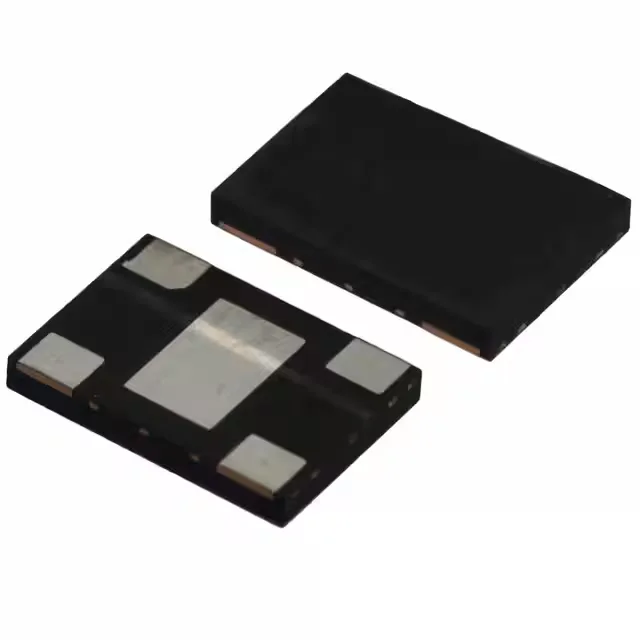
MEMS oscillator at 20 MHz — what changes compared to a crystal
The ASVMB-20.000MHZ-XY-T is a standard XO that uses a MEMS resonator instead of an AT-cut crystal, which shifts the shock and vibration survivability profile significantly. MEMS resonators do not crack under board flex or drop impact the way a crystal blank can, making this a better fit for industrial and instrumentation applications where the board sees thermal cycling and mechanical stress over years of service. At 20 MHz in LVCMOS, the part delivers a square-wave output compatible with most microcontroller and FPGA clock inputs — no external driver stage needed, and the single-ended LVCMOS interface routes cleanly on a two-layer board without the impedance-control overhead of differential schemes.
±10ppm stability across the full industrial temperature band
For a timing reference driving a UART, SPI clock, or sensor sampling clock, ±10ppm at 20 MHz translates to a worst-case frequency error of 200 Hz — well within the tolerance budget for most embedded communication links. The 1.8-3.3 V supply range lets the oscillator sit on the same 1.8 V rail as low-power microcontrollers, or jump up to 3.3 V for compatibility with legacy 3.3 V logic families — a single part number covers both rails without a different voltage variant. Standby current of 15 µA maximum gives the firmware team a clean power-down path: assert the standby pin and the oscillator draws nearly nothing, leaving the downstream device to manage its own sleep state without fighting an always-on reference clock.
4-SMD exposed-pad footprint — what the layout engineer needs to know
The no-lead construction means the side terminations are flush with the body, so the paste footprint must capture the pad lands accurately or the part will tilt during reflow. Maximum seated height is 0.90 mm — low enough for thin-profile assemblies but tight enough that the PCB step-down to the crystal footprint needs to be accounted for in the industrial enclosure stack-up if the board is panel-mounted.