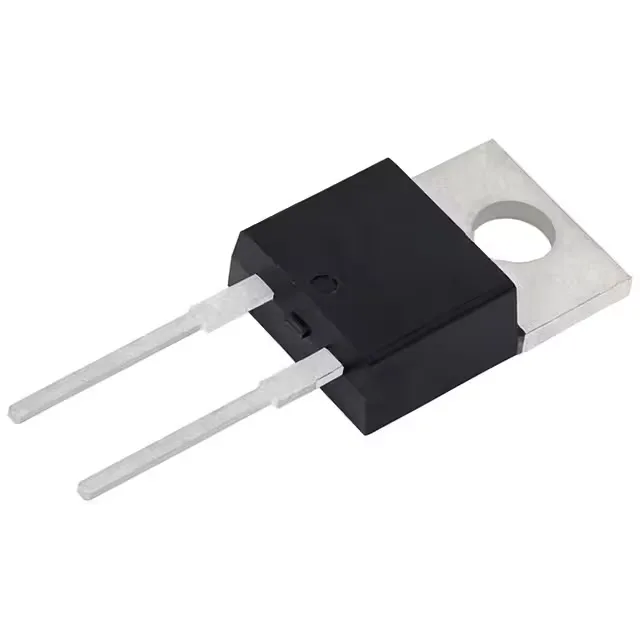
SiC Schottky — zero-recovery switching at 650 V, 20 A
The VS-3C20ET07T-M3 is a 650 V, 20 A silicon carbide Schottky diode from Vishay's Gen 3 merged-pin family.
Thermal headroom — 175 °C junction without derating
That 175 °C ceiling is 25 °C higher than typical silicon fast-recovery diodes, which means the SiC die can sit closer to the hot end of a PFC choke or motor-drive heatsink without needing to derate the forward current. For a 20 A part, that extra margin often saves a heatsink fin or lets you run natural convection where a silicon diode would need forced air.
Forward drop and leakage — the real-world losses
Maximum forward voltage is 1.5 V at 20 A and 25 °C junction. At that current the conduction loss is 30 W peak — a number that drives the heatsink selection. Reverse leakage is 100 µA at 650 V, 25 °C; it rises with temperature, but the SiC leakage curve is far flatter than silicon, so at 150 °C the leakage power is still a small fraction of the conduction loss.
Package and mounting — TO-220AC with standard tab
Supplied in a TO-220-2 (TO-220AC) through-hole package. The two-lead format — anode and cathode — mates with any standard TO-220 heatsink clip or screw-mount tab. The through-hole body suits point-to-point wiring, terminal-block layouts, and rework-friendly assemblies where a surface-mount D2PAK would complicate the thermal path.
No last-time-buy notice or obsolescence date is published. ROHS3 compliant.