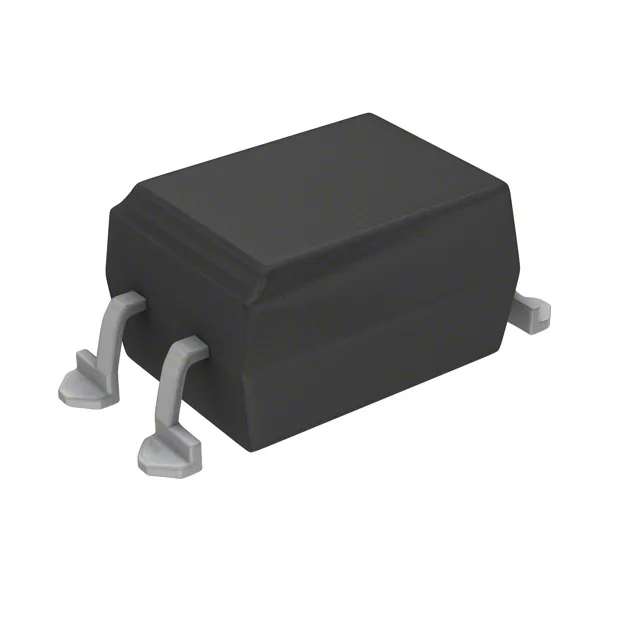
5000Vrms isolation — the spec that decides the BOM line
The VO615A-6X017T from Vishay is a single-channel optocoupler with a DC-input LED and a phototransistor output. The 4-SMD gull-wing package fits standard pick-and-place and reflow processes, and the 100% to 300% current transfer ratio at 5mA forward current gives the designer a predictable range for sizing the collector load resistor and guaranteeing a logic-level swing across the isolation gap.
CTR band and switching speed — what they mean for logic isolation
With a minimum CTR of 100% at 5mA forward current, the phototransistor can sink at least 5mA at the output side — enough to pull a 10kΩ pull-up to a clean logic low for a 5V CMOS or TTL input. The 300% maximum CTR means the designer should not over-drive the LED beyond the 60mA absolute maximum forward current. The 70V output breakdown and 50mA continuous output current give headroom for driving a relay coil or a small MOSFET gate with an external driver transistor.
The operating temperature span from -55°C to 110°C covers industrial outdoor cabinets, engine-bay electronics, and telecom base-station equipment where ambient heat can push junction temperatures above 85°C. The CTR will shift with temperature — expect a slight increase at low temperatures and a decrease above 70°C — so the 100% minimum CTR at 25°C provides margin for the hot-end droop. The 1.43V typical forward voltage at the LED is standard for an IR emitter and easy to drive from a 3.3V or 5V GPIO through a current-limiting resistor.