Isolation rating and what it buys you
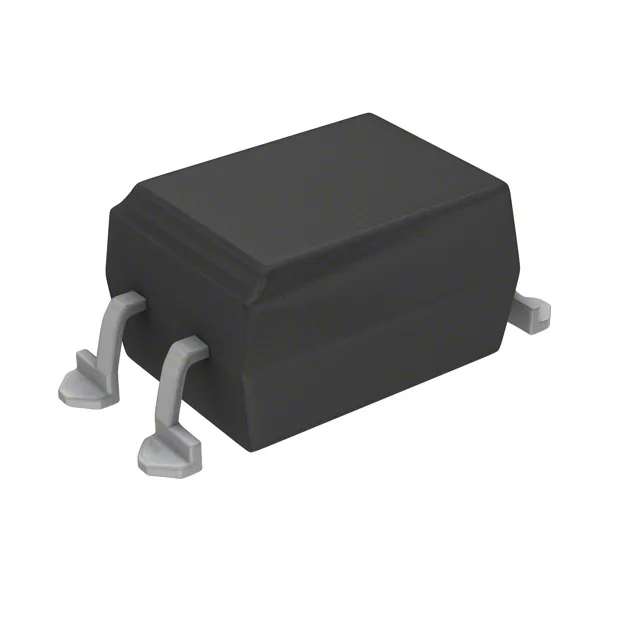
The VO615A-2X007T is a single-channel Vishay optocoupler with a transistor output rated for 5000Vrms isolation between input and output. That 5kV rating puts it in reinforced insulation territory for mains-voltage equipment — think AC-DC power supplies, motor drives, and industrial PLC I/O modules where you need a clean galvanic barrier between the high-voltage side and the low-voltage control logic. The 4-SMD gull-wing package reflows onto the board alongside other passives, no through-hole hand-loading step.
CTR bin and switching speed — the real design parameters
Current transfer ratio is binned at 63% minimum, 125% maximum at 10mA forward current. That 2:1 spread means the designer sizes the pull-up resistor and input drive for the worst-case low end — if the CTR drops to 63%, the output transistor still saturates cleanly with the chosen collector load. At the high end, the extra gain slows the turn-off because stored base charge takes longer to clear; the 3µs rise and 4.7µs fall times are typical at the nominal bias point. Turn-on and turn-off times run 6µs and 5µs respectively, which limits the useful switching rate to roughly 50-100 kHz — fine for relay coil drive, zero-cross detection, and status feedback, but not for isolated data links above a few hundred kbps.
Output voltage and current headroom
The output transistor blocks up to 70V and sinks 50mA continuous per channel. That 70V ceiling covers 24V industrial buses with margin, and 48V telecom rails with some derating. The 300mV Vce saturation at rated current keeps dissipation low enough that the 4-SMD package doesn't need a heatsink — just standard FR4 copper pour. Forward voltage is 1.43V typical at 10mA, so a 3.3V or 5V logic rail drives it directly through a series resistor sized for the 60mA absolute-maximum forward current.
The lower end handles cold-start in northern-climate equipment without the CTR collapse you see in commercial-grade parts below 0°C. For engine-bay or brake-system applications that see 125°C ambient, you'd step up to a 125°C-rated optocoupler — this one's ceiling is 110°C.