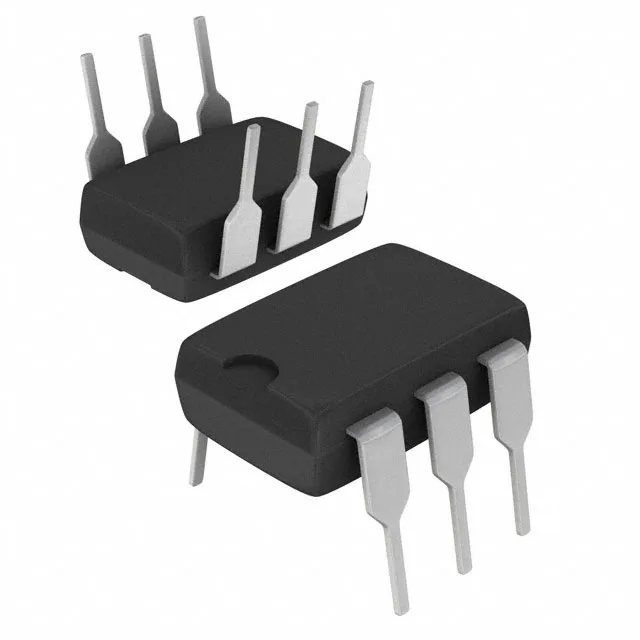
The Vishay TCDT1101 is a single-channel optoisolator with a transistor output, designed to pass DC signals across a galvanic isolation barrier rated at 5000Vrms. That isolation voltage is the part's defining spec: it qualifies the device for safety-rated applications where you need to separate a low-voltage control side from a higher-voltage or noisy power domain — think industrial PLC digital inputs, motor-drive feedback, or AC-mains sensing interfaces. The 6-DIP through-hole package (0.300" body width) is the classic industrial footprint, easy to hand-assemble or wave-solder, and the -55°C to +110°C operating range covers both cold-start environments and warm cabinet interiors.
CTR range and drive margin
The current transfer ratio is specified as 40% minimum and 80% maximum, both measured at a forward current of 10mA. That 2:1 spread is typical for a standard-transistor-output opto — you design the pull-up resistor and logic threshold to work with the worst-case 40% CTR, not the typical. At 10mA input, the output can sink at least 4mA (40% of 10mA), which is enough to drive a TTL or CMOS gate input directly. The 50mA absolute maximum output per channel gives headroom for driving a small relay or LED indicator without an external buffer.
Rise and fall times are 7µs and 6.7µs typical, with turn-on and turn-off times of 11µs and 7µs. That puts the TCDT1101 squarely in the low-speed isolation class — fine for 50/60 Hz line sensing, relay coil drive, or DC state detection, but not for high-speed data or PWM above a few kilohertz. If your application needs faster switching, you would step up to a logic-output optocoupler or a digital isolator.
Package and assembly fit
The 6-DIP through-hole package (7.62mm lead spacing) is a standard industrial form factor. No moisture sensitivity concerns (MSL 1 by default for hermetic DIPs), so no bake required before reflow or wave soldering.