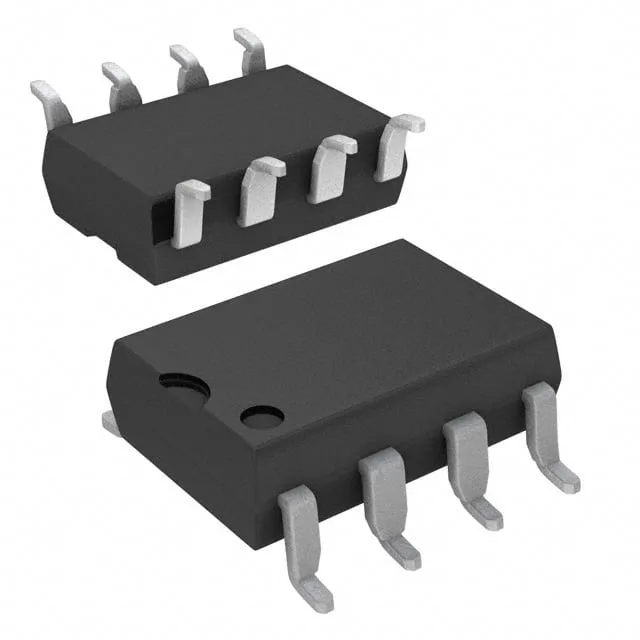
The SFH6136-X009T is a single-channel optocoupler from Vishay with a phototransistor output that brings the base out to a separate pin. That base-access is the detail that matters if you need to bias the transistor for a specific switching threshold or add a speed-up capacitor — most standard optocouplers bury the base internally. It comes in an 8-SMD gull-wing package rated for 5300 Vrms isolation, so it fits into industrial motor drives, PLC I/O modules, and medical power supplies where you need to pass a DC-level signal across a safety barrier without coupling noise back into the control side.
5300 Vrms isolation — what it buys you
The 5300 Vrms isolation rating is the headline number for this part. That is enough for reinforced insulation in mains-connected equipment (think 240 VAC line monitoring or isolated gate drive feedback) and for medical-grade isolation barriers where leakage current has to stay below regulatory limits. The 8-SMD gull-wing package gives you a creepage path that supports that voltage rating — you still need a clean PCB slot underneath the part to maintain the clearance, but the package itself is not the weak link.
200 ns switching — fast enough for most digital isolation
Turn-on and turn-off both spec at 200 ns typical. That is fast enough to isolate a PWM signal at a few hundred kHz or to pass a UART data stream without bit errors. The base-access pin means you can trade switching speed for noise margin by adding a small capacitor from base to emitter — useful if the signal path runs through a noisy industrial environment. If you need sub-100 ns propagation delay, you would step up to a logic-output optocoupler; for most PLC I/O and relay-drive isolation, 200 ns is plenty.
Temperature range and field-replaceability
The surface-mount gull-wing leads are field-serviceable with a hot-air station — no lab bench required. Just watch the orientation: the pin-1 mark is the cathode side of the LED, and the base pin is on the output side opposite the emitter. If you are swapping one in a repair, double-check the silk screen against the datasheet footprint; the 8-SMD package is small enough that a 180° rotation is easy to miss.
ROHS3 compliant. If you are filling a BOM line for a new design or a repair, this one is not going to disappear mid-cycle.