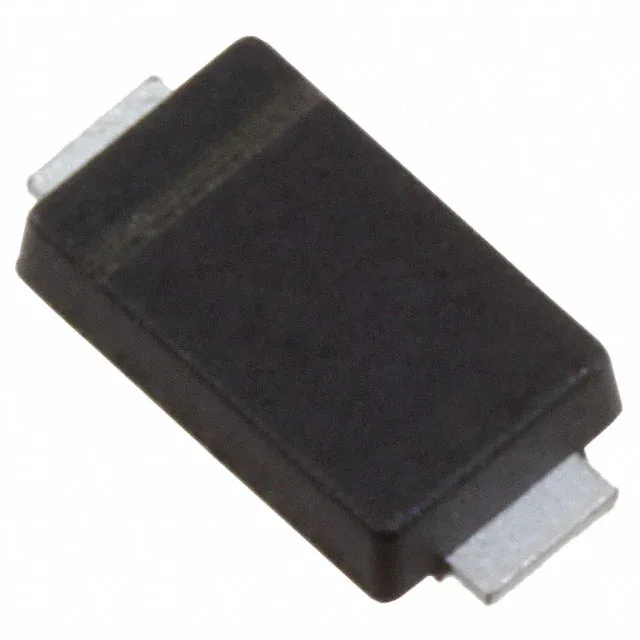
Vishay SE50PAJHM3/H

Vishay SE50PAJHM3/H 600V 1.6A Standard Rectifier, AEC-Q101

MPNSE50PAJHM3/H
End of Life

Vishay SE50PAJHM3/H, Automotive AEC-Q101 standard-recovery rectifier, 600V Vr, 1.6A Io, 2µs trr, DO-221BC (SMPA) surface-mount package, -55°C to 175°C junction.

$0.58Ref. price · indicative, final on quote
PackagingDO-221BC, SMA Flat Leads Exposed Pad
StockContact for availability
MOQ1 pcs
  • 100% new & originalTraceable channels only — no refurbs, no pulls, no remarked parts.
  • Date & lot codes on quoteStated per line before you commit; label photos on request.
  • MSL-compliant ESD packingMoisture-sealed bags with indicator cards; reels photo-verified.
  • PayPal buyer protectionPay by T/T, PayPal or Payoneer — card payments covered end to end.

Specifications

SE50PAJHM3/H Technical Specifications
ParameterValue
SeriesAutomotive, AEC-Q101
Diode typeStandard
Mounting typeSurface Mount
Voltage - DC reverse (Vr)600 V
Voltage - forward (Vf) (Max) @ if1.16 V @ 5 A
Current - reverse leakage @ vr10 µA @ 600 V
Current - average rectified1.6A
Operating temperature - junction-55°C ~ 175°C
SpeedStandard Recovery >500ns, > 200mA (Io)
PackageTape & Reel (TR); Cut Tape (CT)
CaseDO-221BC, SMA Flat Leads Exposed Pad
Capacitance @ vr, f32pF @ 4V, 1MHz
Reverse recovery time2 µs

Product details

AEC-Q101 standard-recovery rectifier for automotive bias supplies

The Vishay SE50PAJHM3/H is a 600 V, 1.6 A standard-recovery rectifier in the DO-221BC (SMPA) surface-mount package, qualified to AEC-Q101 for automotive applications. It is a general-purpose silicon diode with a reverse recovery time of 2 µs, placing it in the standard-recovery class (>500 ns at >200 mA). The junction temperature range spans -55°C to 175°C, covering under-hood and chassis-domain thermal environments.

600 V blocking, 1.6 A forward — where it fits the power budget

With a 600 V DC reverse voltage rating and 1.6 A average rectified forward current, this part is sized for auxiliary and bias-supply rectification in automotive systems — think DC-DC converter secondary-side rectification, relay and solenoid flyback clamping, or OR-ing diodes in power distribution modules. The 1.16 V forward voltage drop at 5 A gives a conduction-loss ceiling; at the 1.6 A average rating the actual Vf will be lower, but the 5 A point confirms the die can handle surge events well above the continuous rating. Reverse leakage is 10 µA at the full 600 V blocking voltage, which is typical for a 175°C-rated junction — expect leakage to rise with temperature, but the 10 µA figure at 25°C gives a clean baseline for the off-state power dissipation calculation.

2 µs reverse recovery — the switching-speed ceiling

The 2 µs trr confirms this is a standard-recovery, not fast-recovery, diode. In a 50 Hz or 60 Hz line-frequency rectifier the 2 µs recovery is invisible, but in a 100 kHz+ switching supply the recovery losses will dominate. This part belongs in the line-frequency or low-frequency switched stage — input bridge rectification, pre-charge circuits, or DC bus clamping — not the high-side synchronous rectifier position.

DO-221BC (SMPA) — footprint and thermal management

The DO-221BC (SMPA) package has exposed pad — the cathode tab is the thermal path. The board-side copper area under the pad sets the junction-to-ambient thermal resistance; for 1.6 A continuous in a 105°C ambient, a minimum 30 mm x 30 mm copper island on a 2 oz inner layer is typical to keep Tj below 150°C. The SMA Flat Leads profile reduces the package height compared to a standard SMA, which matters in potted or conformal-coated assemblies where clearance is tight.

Frequently asked questions

What is the reverse recovery time of SE50PAJHM3/H?

The reverse recovery time (trr) is 2 µs. This classifies it as a standard-recovery diode (>500 ns at >200 mA), suitable for line-frequency rectification but not for high-frequency switching stages.

Is SE50PAJHM3/H AEC-Q101 qualified?

Yes, the SE50PAJHM3/H is part of the Automotive series and is AEC-Q101 qualified. This means it has passed the stress tests for automotive-grade components, including high-temperature reverse bias, temperature cycling, and humidity.