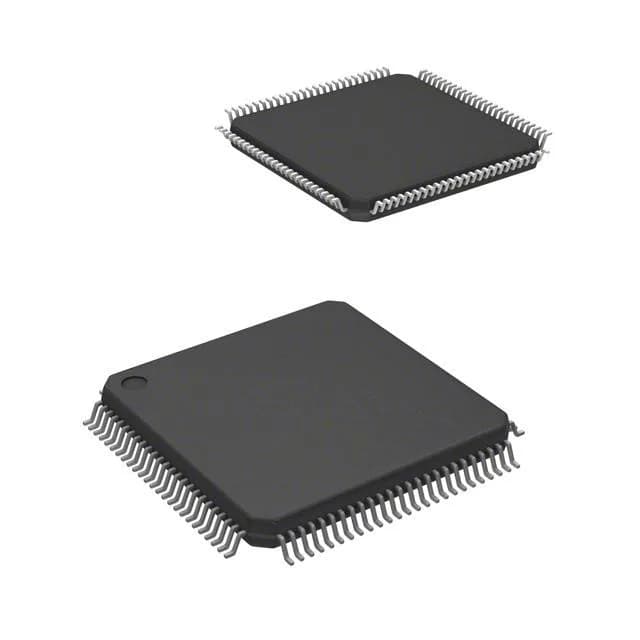
Its 40 MHz core clock delivers enough throughput for moderate sensor fusion, UART/I²C communication, and real-time control loops without pushing into the higher-cost Cortex-M4 or M7 tiers. The 78 I/O lines in a 100-LQFP package give you room for parallel LCD buses, keypad matrices, or multiple sensor interrupts without multiplexing. The integrated 12-channel 10-bit ADC handles analog inputs like potentiometers, current shunts, or temperature sensors directly, reducing external component count.
Temperature range and operating environment
It is not specified for automotive under-hood or extended industrial (-40°C) environments, so if your design sees cold starts below -20°C, look at the wider-temperature variants in the TX03 family.
Supply rail and power-up
The POR (Power-On Reset) and WDT (Watchdog Timer) peripherals are on-chip, so external supervisor ICs are optional unless you need a precise reset threshold or a longer watchdog timeout than the internal one provides.
Connectivity and clocking
The I²C, SIO, and UART/USART interfaces handle common serial peripherals — talking to EEPROMs, sensor modules, or a host controller. The external oscillator input means you can use a crystal or ceramic resonator for accurate timing; no internal RC is mentioned, so plan for an external clock source in your BOM.
Lifecycle and sourcing posture
Listed as Active by Toshiba with RoHS compliance confirmed.