5000 Vrms isolation — why this matters for gate drive
The TLP5771(D4,E is a 1-channel optical-coupling gate driver rated for 5000 Vrms isolation. That isolation voltage is the spec that lets you run the output side at a different ground potential than the controller — essential in motor drives, inverters, and industrial power supplies where the high-side gate reference swings above the DC bus. Peak output current is 1 A, enough to drive the gate of a small IGBT or MOSFET module with a gate charge up to roughly 1 µC at moderate switching frequencies. The output stage can source and sink 1 A symmetrically, so turn-on and turn-off current capability are matched.
35 kV/µs CMTI — keeps the output from false-switching
Common-mode transient immunity is specified at a minimum of 35 kV/µs. In a motor drive, when the IGBT switches off, the DC-bus voltage can slew at tens of kV/µs across the isolation barrier. Propagation delay is 150 ns max with a pulse-width distortion of 50 ns max.
Active production — no LTB watch needed
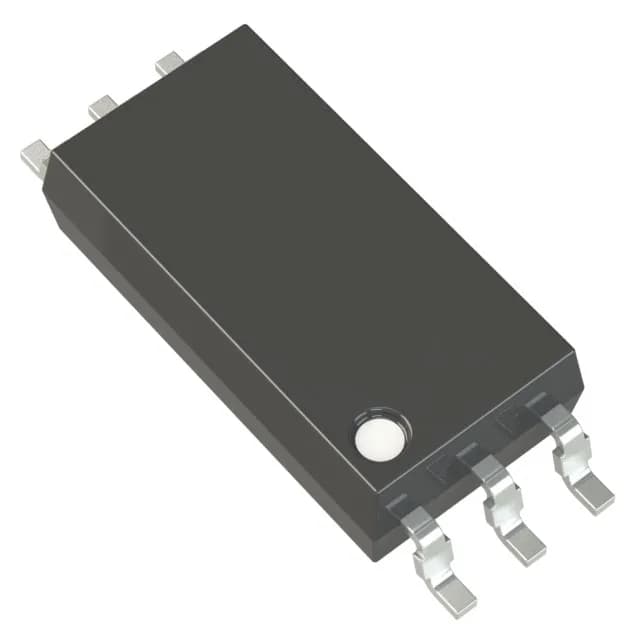
RoHS compliant. The 6-SOIC package with 7.50 mm body width is a common footprint for high-isolation optocouplers. The wide body gives the creepage distance needed to maintain the 5000 Vrms rating across the PCB.
Temperature range and approvals
Operating temperature spans -40°C to 110°C, covering industrial and most automotive under-hood environments. The supply voltage range is 10 V to 30 V, which matches common gate-drive bias rails. Safety approvals include CQC, cUR, UR, and VDE — the VDE mark is often a hard requirement for European motor-drive and power-supply designs.