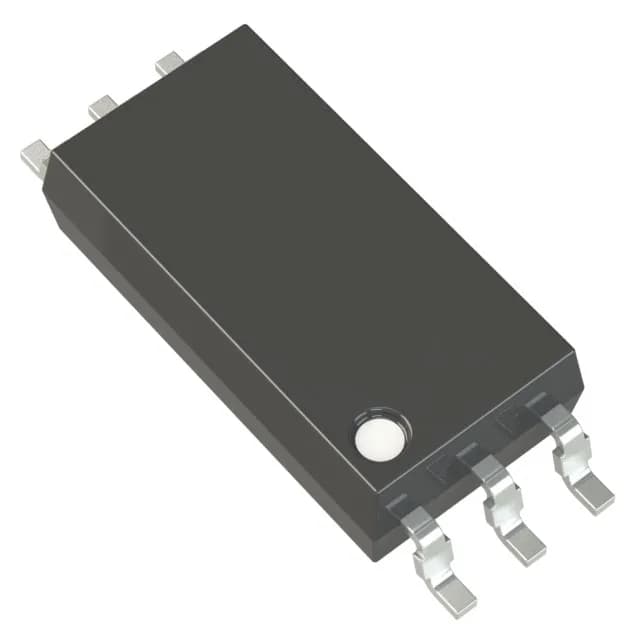
2.5 A peak output — what it drives and what it doesn't
The TLP5752(D4-TP,E is a single-channel optical coupling gate driver from Toshiba, built for driving IGBTs and power MOSFETs in industrial inverter and motor-drive stages. Its 2.5 A peak output current (sink and source both rated 2.5 A) is enough to switch medium-power modules directly — think 600 V / 30 A IGBTs in a servo drive or a solar inverter leg. If you are pushing a larger module with higher gate charge, you will need an external buffer stage; the 2.5 A figure is the ceiling per channel.
5000 Vrms isolation and 35 kV/µs CMTI
Reinforced isolation rated at 5000 Vrms, backed by approvals from CQC, CSA, cUL, UL, and VDE — this part clears the safety barrier for mains-connected power stages. The common-mode transient immunity of 35 kV/µs minimum is the spec that matters when the high-side switch sees a fast dv/dt event: below that threshold the output can glitch, turning on the wrong device. In a hard-switched inverter running 10–20 kV/µs switching edges, the 35 kV/µs margin gives comfortable headroom.
Timing: 150 ns propagation delay, 50 ns pulse-width distortion
Propagation delay is matched at 150 ns max for both rising and falling edges, with pulse-width distortion held to 50 ns. That symmetry keeps dead-time consistent across the phase leg — important when you are programming a few hundred nanoseconds of dead-time to avoid shoot-through. Rise and fall times of 15 ns and 8 ns typical mean the gate drive waveform is clean enough for switching frequencies up to a few tens of kHz without excessive switching loss.
The output-side supply accepts 15 V to 30 V, covering the standard gate-drive rails for IGBTs (typically +15 V on, 0 V or -5 V off). The 1.55 V typical forward voltage and 20 mA max forward current on the LED side are standard for a photonic coupler — no surprises for the input-stage design.
Package and mounting
Housed in a 6-SOIC package with 7.50 mm body width and 0.295" lead pitch — the wide-body SOIC-6 footprint that is common for reinforced isolation devices.
Lifecycle and sourcing
It is a current-production part from Toshiba, RoHS-compliant, and available through independent distribution.