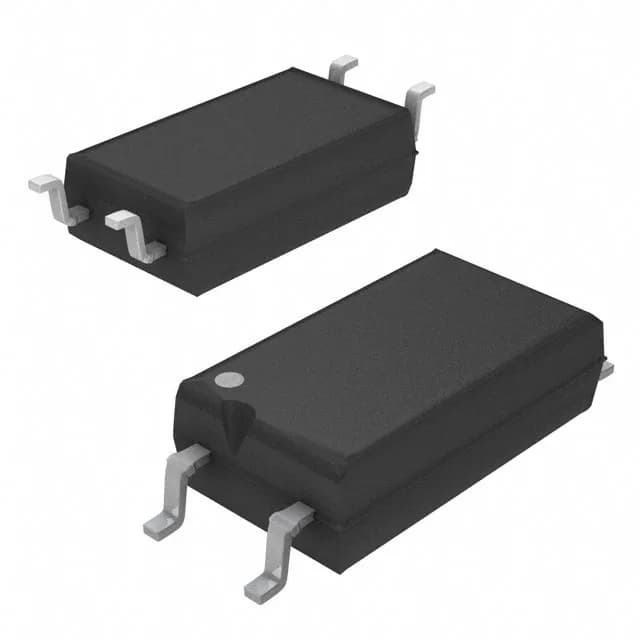
High-voltage transistor output optocoupler for industrial isolation
The Toshiba TLP388(TPR,E is a single-channel transistor output optocoupler designed for applications requiring reinforced isolation and a high collector-emitter voltage rating. The current transfer ratio spans 50% to 600% at 5mA forward current, giving you a wide operating margin over temperature and device lifetime. The 400mV Vce(sat) maximum keeps the output drop low enough to drive logic inputs or a downstream transistor directly.
The 5000Vrms isolation rating is the reinforced-level barrier you need for safety-isolated power-supply feedback loops, motor-drive gate-drive interfaces, and medical equipment where the clearance and creepage path must pass IEC 60950 or 60601. In a 6-SOIC-4 package with only 4 leads, the physical spacing is tight — the 5000Vrms figure tells you the internal opto stack and mould compound are built for it, but you still need to verify PCB creepage distance for your working voltage.
350V VCEO — not your 30V optocoupler
The 350V maximum collector-emitter voltage is the distinguishing spec. This is not a generic 30V or 80V transistor output — it is designed for circuits that switch or sense on a high-voltage DC bus, such as 250V or 300V rail monitoring in PFC stages, offline flyback feedback, or 277VAC industrial control inputs.
Switching speed and drive considerations
Rise and fall times are 2µs and 3µs typical, with turn-on and turn-off both at 3µs typical. That puts the useful switching frequency around 50-100 kHz for digital signals — fine for isolated PWM feedback at moderate frequency, but not for high-speed data or gate-drive at hundreds of kHz. The 1.25V typical forward voltage and 50mA max forward current are standard for an LED-driven input; the 50% minimum CTR at 5mA ensures the output can saturate even with a weak drive from a 3.3V or 5V logic pin through a current-limiting resistor.
Package and mounting
Supplied in a 6-SOIC package with 4 leads (the two centre pins are omitted for creepage), surface-mount only. The 4-lead SOIC footprint is compact — verify the pad layout against your assembly house's stencil design to avoid solder bridging on the narrow body.