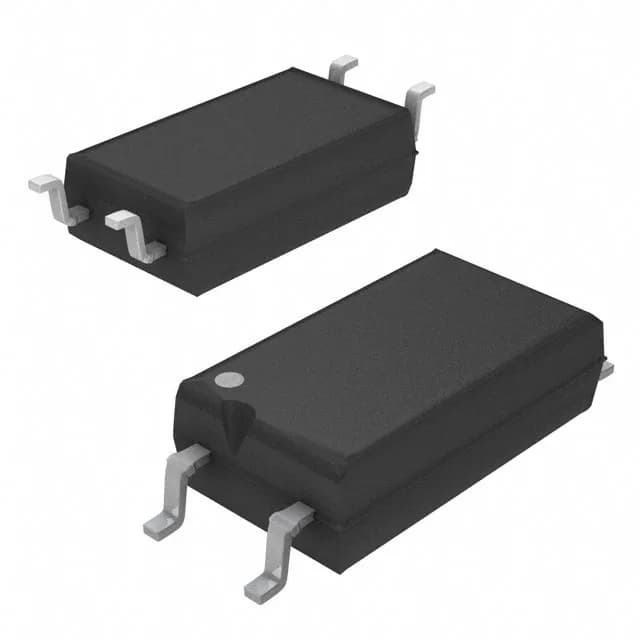
The Toshiba TLP385(YH,E is a single-channel transistor-output optocoupler in a compact 6-SOIC (0.173", 4.40mm width) package that uses only 4 leads — the extra two pin positions are omitted in the molded body, saving board area compared to a standard 6-pin SOIC. The 80V Vce(max) on the output transistor is notably higher than the common 30V or 40V ceiling on many phototransistor optocouplers — it gives headroom when switching 24V industrial rails with margin for transients, or when driving a small relay coil directly without a secondary buffer transistor. Current transfer ratio (CTR) is specified at 75% minimum and 150% maximum, both measured at 5mA forward current. This 2:1 spread is tighter than the standard 'Y' rank (50-150%) or 'GB' rank (100-300%) in the same TLP385 family — the 'YH' rank reduces LED drive uncertainty for designs that need a predictable on-state collector current without overdriving the input side.
Switching speed and drive margin for the interface designer
Rise and fall times are 2µs and 3µs typical respectively, with symmetrical turn-on and turn-off times of 3µs each. This places the TLP385(YH,E in the standard-speed phototransistor category — adequate for 10-100 kHz switching in digital isolator replacement, PLC input sampling, or status feedback, but not for high-speed gate drive or isolated serial communication above 1 Mbps. The 300mV Vce(saturation) at the output is typical for phototransistors at low collector current — it leaves about 3.7V logic-high margin when pulled up to 5V through a 10kΩ resistor, which suits 5V CMOS and TTL inputs. For 3.3V logic, factor the saturation voltage into the noise margin budget. Forward voltage is 1.25V typical at the LED, and the LED is rated for 50mA continuous forward current. The 5mA test condition for the CTR spec is the design sweet spot — driving at 5-10mA gives a clean logic-level output while keeping the LED well below its absolute maximum, which matters for long-term reliability in 105°C ambient environments.
Temperature range and deployment environments
Operating temperature spans -55°C to 110°C, which covers military/aerospace cold-soak and industrial hot-box conditions. The 110°C upper limit is 5-10°C above typical commercial optocouplers (usually 100°C), giving extra margin in confined enclosures or near hot components like IGBTs and power resistors. The two unused pin positions are depopulated in the mold, so the footprint matches a 4-pin SSO package. Verify the land pattern against the mechanical drawing; it is not a standard 6-pin SOIC layout.
Lifecycle and compliance
For production programs, the active status removes the urgency to qualify an alternate, though the CTR rank differences across the TLP385 family (Y, GB, GRL) mean a substitute would require re-verifying the LED drive resistor.