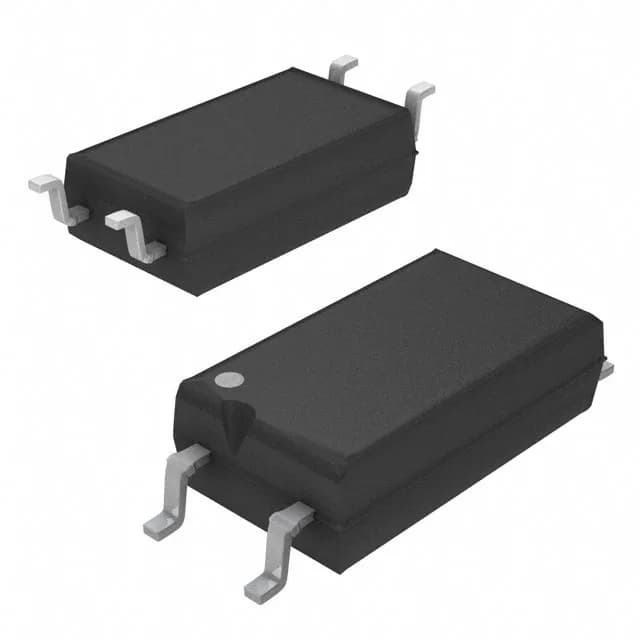
What this optocoupler does — and the GRH CTR rank
The Toshiba TLP385(GRH-TPR,E is a single-channel, DC-input, transistor-output optocoupler in a surface-mount package with four leads. Its primary job is to pass a logic-level or low-current signal across a galvanic isolation barrier rated at 5000Vrms, while protecting the low-voltage side from transients on the high-voltage side. The GRH suffix denotes a current transfer ratio (CTR) bin of 150% to 300% at a forward current of 5 mA — a middle-range rank that suits general-purpose isolation in industrial controls, PLC I/O modules, motor-drive feedback, and power-supply secondary-side monitoring. The output transistor can handle up to 80 V and 50 mA continuous, enough to drive a downstream logic input, a small relay coil, or a DC load directly.
The 150% to 300% CTR range at 5 mA forward current means that with 5 mA through the LED, the output transistor can sink between 7.5 mA and 15 mA (collector current). That spread is wide enough that you size the pull-up resistor for the minimum CTR case to guarantee the output saturates — the 300mV Vce saturation figure at that current is the ceiling. If your design needs a tighter CTR window for consistent timing or load current, the TLP385 family offers other ranks: the GRL bin (lower CTR) or GB bin (higher CTR). The GRH sits in the middle, which is the default pick for most general-purpose isolation where you want reasonable LED current without over-driving the LED.
Temperature range and environment
Rated for -55°C to 110°C operating temperature, this optocoupler covers the full industrial temperature range and extends into the cold end that matters for outdoor telecom cabinets, solar inverters, and engine-bay electronics that see cold starts.
Switching speed and timing
Rise and fall times are 2 µs and 3 µs typical, with turn-on and turn-off times both at 3 µs typical.