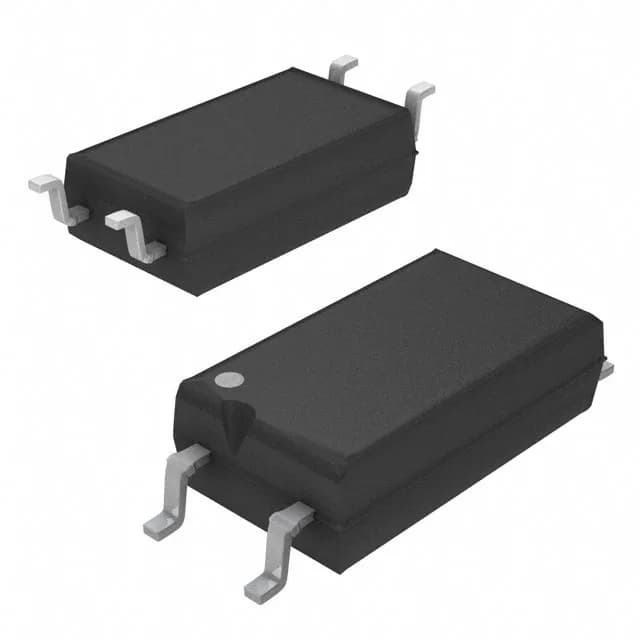
What this optocoupler does in the assembly
The Toshiba TLP385(GB-TPR,E is a single-channel transistor-output optocoupler in a compact 4-lead SOIC-6 package. It provides 5000Vrms of galvanic isolation between a DC input LED and a phototransistor output, making it a straightforward choice for breaking ground loops, translating logic levels across an isolation barrier, or driving low-side loads in industrial and power-conversion circuits.
The 5000Vrms isolation voltage is the defining spec for this optocoupler. It qualifies the part for reinforced insulation in mains-connected equipment — think AC-DC power supplies, motor drives, and industrial sensors that need to keep the low-voltage control side electrically separate from the high-voltage power stage. For a designer, this rating means the TLP385 can sit across a safety barrier without needing a separate isolation transformer or a more expensive digital isolator, as long as the data rate stays within its switching limits.
CTR range and switching speed — design margin callouts
The current transfer ratio spans 100% minimum to 600% maximum at a forward current of 5mA. That wide spread means the output transistor can sink anywhere from 5mA to 30mA for the same 5mA input — the designer must bias the output pull-up for the worst-case minimum CTR, not the typical mid-point. The rise and fall times are 2µs and 3µs respectively, with turn-on and turn-off both at 3µs typical. This is a slow optocoupler suited for DC signal isolation, 50/60Hz zero-crossing detection, or low-speed digital interfaces up to a few tens of kilohertz — not for high-speed comms like SPI or CAN.
Output ratings and package
The output transistor is rated for 80V maximum collector-emitter voltage and 50mA continuous output current per channel, with a typical Vce(saturation) of 300mV. That gives enough headroom to drive a small relay, a logic gate input, or a low-side MOSFET gate through a resistor. The package is a 6-SOIC body with only 4 leads populated — a 4.40mm wide SOIC footprint that hand-solders easily. The forward voltage is a typical 1.25V, and the LED can take up to 50mA continuous DC forward current.
Lifecycle and sourcing
It is RoHS compliant per the listing.