What the 5000Vrms isolation rating means for your barrier design
The TLP385(D4-Y,E delivers 5000Vrms isolation between input and output — a figure that qualifies it for reinforced insulation in mains-connected industrial controls, motor drives, and power supplies where safety standards like IEC 60950-1 or IEC 62368-1 apply. With a DC input and transistor output, this part is a straightforward choice for logic-level isolation: the phototransistor saturates with a Vce of 300mV max at the rated forward current, keeping the output swing close to the supply rail.
CTR window and switching speed — sizing the drive margin
The current transfer ratio is specified at 50% min and 150% max when the LED is driven at 5mA — a 3:1 spread that demands the designer check the minimum CTR against the load current at the lowest operating temperature, where CTR typically drops. Typical rise and fall times of 2µs and 3µs, with turn-on/turn-off times of 3µs each, place this opto in the medium-speed class — adequate for 10-100 kHz PWM or serial data up to a few hundred kbps, but not for high-speed isolated communication like I²C or CAN. The 80V output rating and 50mA continuous output current per channel give enough headroom to drive a relay coil, a gate driver input, or a PLC digital input module directly.
Active production — sourcing posture for this Toshiba opto
The part is RoHS compliant, with no exemptions noted; the 6-SOIC-4 package is a standard surface-mount footprint that is widely second-sourced across the industry.
Package and temperature grade — board-level fit
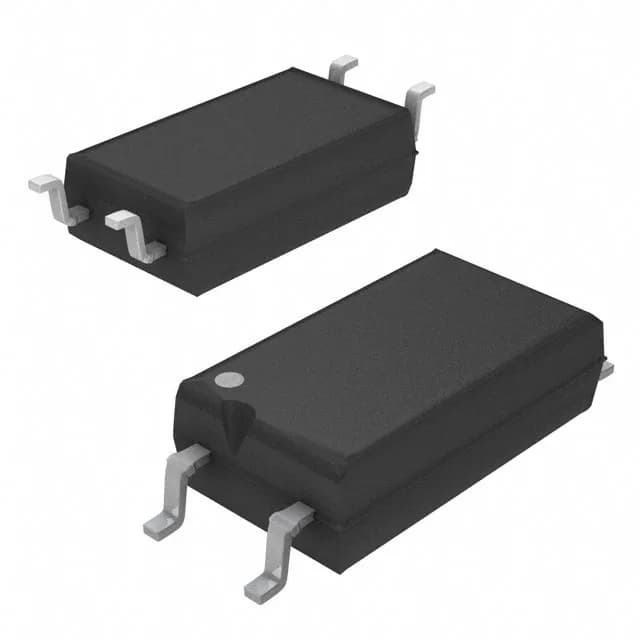
Housed in a 6-SOIC with 4 leads (0.173" body width, 4.40mm height), the package is a compact alternative to the 4-pin DIP, saving about 40% board area while maintaining the same 5000Vrms isolation rating. Rated for -55°C to 110°C operating temperature, this opto spans industrial and extended-commercial environments — suitable for outdoor telecom cabinets, factory-floor sensors, and engine-bay electronics where the ambient can reach 85°C with self-heating.