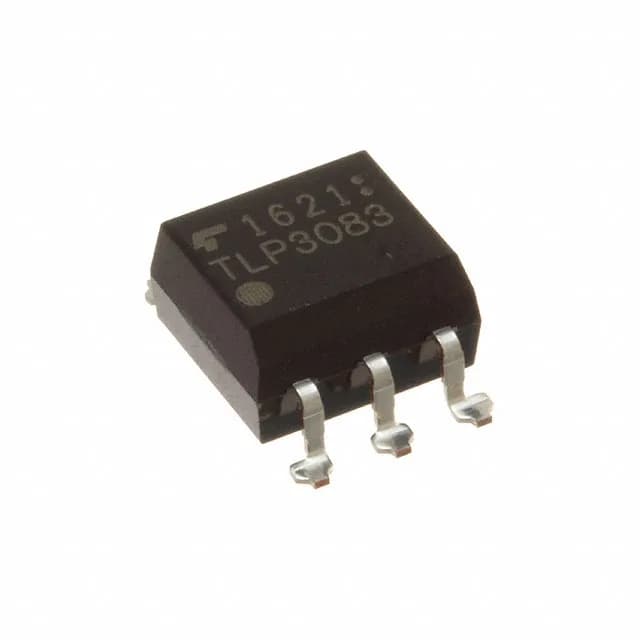
5000Vrms isolation, 800 V off-state — what this optotriac handles
The Toshiba TLP3073(TP1,F is a single-channel optotriac coupler with a triac output, designed for isolated AC switching in industrial and appliance controls. Its headline ratings are 5000Vrms isolation between input and output and an 800 V off-state blocking voltage, which together let it drive loads directly on 240 VAC mains with a healthy safety margin. The output is non-zero-crossing, meaning the triac fires immediately when the LED is driven — this matters for phase-control applications like dimmers or soft-start circuits where you want to trigger at any point in the AC cycle, not just the zero-cross. The 100 mA on-state RMS current is sized for driving a larger external triac or a small load like a solid-state relay coil, not for direct high-current switching.
Package and rework — 6-SMD gull-wing
The TLP3073(TP1,F comes in a 6-SMD package with 5 leads and gull-wing leads, surface-mount. The gull-wing form is rework-friendly — you can hand-solder or hot-air rework it without special equipment, and the 5-lead layout has a clear pin-1 mark. The supplier device package is 6-SO, 5 lead. The tape-and-reel and cut-tape options cover both production reels and prototype quantities.
Industrial temperature range and approvals
The part carries CQC, cUR, and UR approvals, meaning it meets Chinese, Canadian, and US safety standards for reinforced insulation. ROHS3 compliant.
LED drive characteristics
The input LED has a typical forward voltage of 1.15 V and a maximum DC forward current of 50 mA. The LED trigger current (Ift) is 5 mA max, so a standard 5 V or 3.3 V logic output with a series resistor can drive it directly. Typical hold current is 1 mA. The static dV/dt rating is 2 kV/µs typical, which gives good noise immunity against fast transients on the AC line — important for avoiding false triggering in noisy environments.
Lifecycle and sourcing
For dual-sourcing or supply resilience, the TLP3052 is a pin-compatible non-zero-crossing sibling with a lower 600 V off-state rating — check the off-state voltage requirement before substituting.