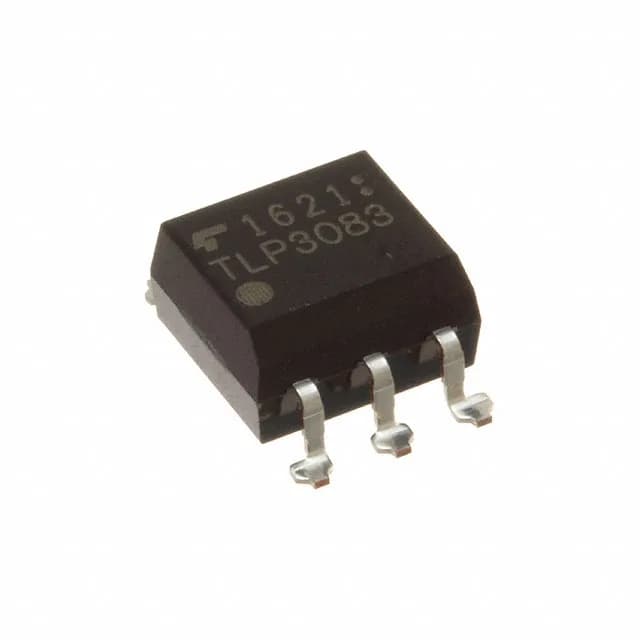
Zero-crossing triac driver for AC load switching
The Toshiba TLP3062A(TP1,F is a single-channel triac output optocoupler with a built-in zero-crossing circuit, designed to drive low-current AC loads such as solid-state relays, solenoid valves, and small motors from a logic-level input. The zero-crossing feature gates the triac on only when the AC line voltage is near zero, which significantly reduces inrush current and conducted EMI compared to random-phase turn-on.
5000 Vrms isolation and 600 V off-state — mains-rated barrier
With a 5000 Vrms isolation voltage rating, the TLP3062A provides reinforced insulation between the low-voltage control side and the mains-voltage load side, suitable for equipment requiring a robust safety barrier per IEC standards. The 600 V off-state voltage allows direct switching of 240 VAC or 277 VAC lines with adequate margin for line transients. The 100 mA maximum on-state RMS current covers small loads like indicator lamps, contactor coils, and solid-state relay input stages — for higher current loads, the optocoupler drives an external triac or SCR.
2 kV/µs dV/dt immunity — false-trigger protection in noisy environments
The minimum static dV/dt of 2 kV/µs (typical) ensures the output triac does not falsely trigger from fast-rising voltage transients on the AC line, such as those caused by nearby relay switching, motor brushes, or inductive load turn-off. This is a critical parameter for industrial and appliance designs where conducted noise is unavoidable. The typical hold current of 600 µA means the triac will latch on once triggered and only turn off when the load current drops below that threshold near the AC zero crossing, which is consistent with the zero-crossing turn-on behavior.
It is RoHS compliant and holds agency approvals from CQC, cUR, and UR, covering the Chinese, US, and Canadian safety markets.
LED drive requirements — 1.15 V forward, 10 mA trigger
The input LED has a typical forward voltage of 1.15 V and a maximum trigger current of 10 mA to guarantee the output triac turns on. The 10 mA trigger threshold is standard for this class of optocoupler and allows direct interface with GPIO pins or open-collector drivers without a buffer stage.