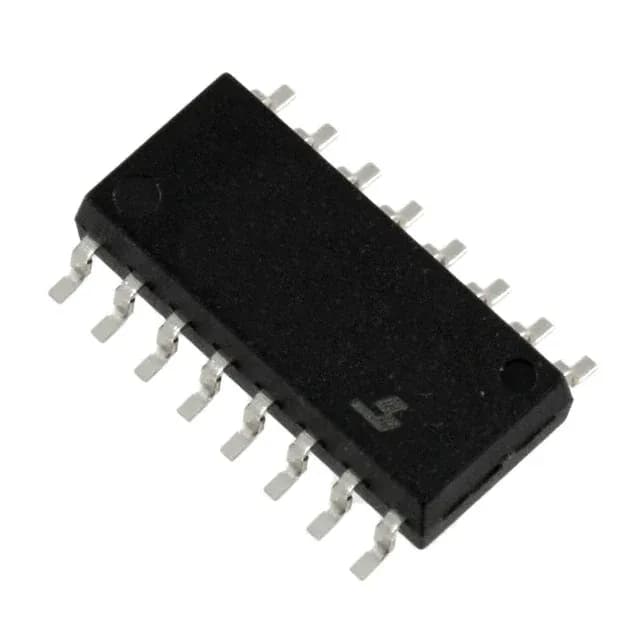
Four independent isolation channels in a single SO-16
The TLP293-4(4LGBTRE: The TLP293-4 packs four phototransistor output channels into a 16-SOIC package, saving board area and per-channel cost compared to using four single-channel optoisolators. Each channel is rated for 3750Vrms isolation between input and output — a common threshold for basic isolation in 24V industrial control, PLC digital inputs, and motor-drive feedback paths. The DC input side takes a forward current up to 50 mA with a typical forward voltage of 1.25V. On the output side, each transistor can handle up to 80V and 50 mA continuous, with a maximum Vce saturation of 300 mV — enough to drive a logic input or a small relay coil directly.
Wide temperature range and switching speed for harsh environments
The 2 µs rise and 3 µs fall times (typical) keep switching fast enough for 24V digital inputs running at a few kHz, but not for high-speed serial buses — that is not what a phototransistor output is built for. The current transfer ratio spans 100% to 600% at a forward current of 500 µA. The 100% minimum guarantees the output transistor saturates with a reasonable load, while the wide spread means the designer must account for CTR variation over temperature and LED aging — a typical derating exercise for any optocoupler-based design.
Active production, ROHS3 compliant, surface-mount package
It is ROHS3 compliant, so no exemption expiry to track. The 16-SOIC package (0.179" body width, 4.55 mm) is a standard footprint; the supplier device package is listed as 16-SO. Tape & Reel and Cut Tape options are available, covering both production reels and prototype quantities. No minimum order quantity is imposed by the lifecycle status; we can source small volumes or full reels.
Rework and layout notes for the 16-SOIC package
The 16-SOIC with 0.179" body width is a standard SOIC-16 footprint. The lead pitch is 1.27 mm, which is forgiving for hand soldering or hot-air rework. No exposed pad means no thermal paste stencil to worry about; just a standard land pattern. Keep the creepage distance under the part clean — the 3750Vrms rating relies on the mould compound and the spacing between input and output pins. If you are reworking a board, preheat the board to 100°C to reduce thermal shock. The SO-16 leads are on 0.050" pitch — a fine chisel tip or hot air at 300°C with low flow will lift the part cleanly without lifting pads. Clean flux residue after rework; any ionic contamination across the isolation barrier can degrade the isolation voltage over time.